
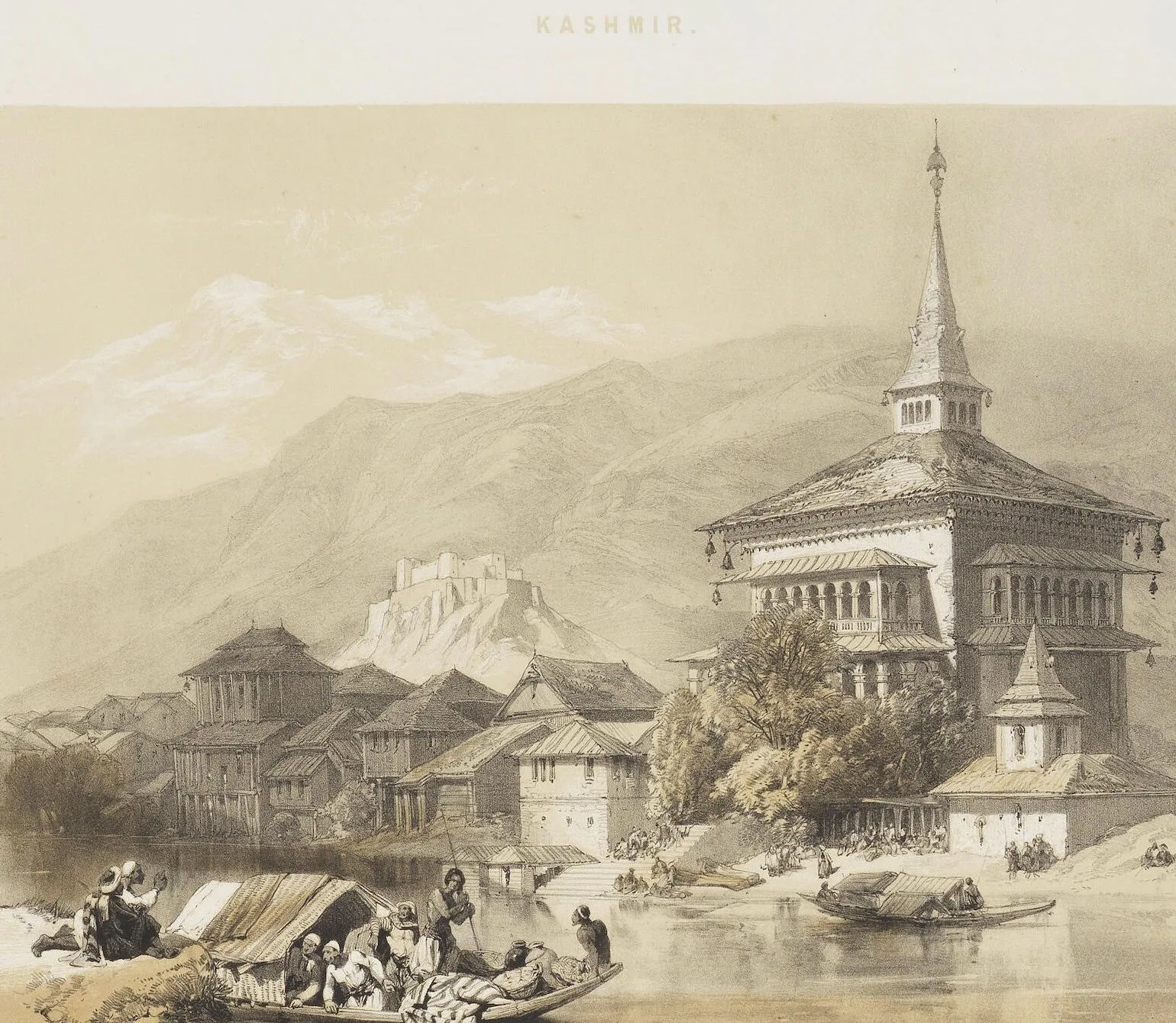
Srinagar's most significant wooden mosques are Shah-i-Hamdan (Khanqah-e-Moula, originally 14th century, papier-mache interior), Jamia Masjid in Nowhatta (1402, rebuilt multiple times after fires, 380 deodar columns), and Makhdoom Sahib shrine on the Hari Parbat hillside. The architecture is distinctly Kashmiri -- multi-tiered wooden roofs stacked in a pagoda style, finished with a single tapering spire, built without minarets in the original form. Via Kashmir's viakashmir.in/cabs handles old city transfers with drivers who know the narrow lanes near the mosques.
Want an old city Srinagar visit in your itinerary?
Via Kashmir's viakashmir.in/cabs handles old city transfers -- the team knows the parking points nearest each mosque and the best approach routes through the narrow lanes. For a curated old city walk with local context, viakashmir.in/packages handles that too. Enquire at viakashmir.in/enquire/general.
In This Article
- At a Glance: Srinagar Wooden Mosque Heritage Walk
- What Makes Kashmiri Mosque Architecture Different from Mughal Mosques?
- Shah-i-Hamdan Mosque: Where to Start the Walk
- Jamia Masjid, Nowhatta: The Friday Mosque of Srinagar
- Is a Srinagar Wooden Mosques Walk Worth a Half-Day?
- Makhdoom Sahib Shrine: The Hillside View
- Srinagar Old City vs Dal Lake Boulevard: Which to Prioritise?
- A Quotable Local Observation
- Frequently Asked Questions: Srinagar Wooden Mosques Heritage Walk
Quick Answer: Srinagar's most significant wooden mosques are Shah-i-Hamdan (Khanqah-e-Moula, originally 14th century, papier-mache interior), Jamia Masjid in Nowhatta (1402, rebuilt multiple times after fires, 380 deodar columns), and Makhdoom Sahib shrine on the Hari Parbat hillside. The architecture is distinctly Kashmiri -- multi-tiered wooden roofs stacked in a pagoda style, finished with a single tapering spire, built without minarets in the original form. Via Kashmir's viakashmir.in/cabs handles old city transfers with drivers who know the narrow lanes near the mosques.
Most visitors to Srinagar spend their time on the boulevard, the Mughal gardens, and the main tourist circuit. The old city -- the dense, lane-narrow quarter on the western shore of Dal Lake -- rarely appears on the day plan. It is a different city inside the city.
Its mosques and shrines are the reason to go. Not because they are famous, but because they represent an architectural tradition that exists nowhere else on the subcontinent -- and most people drive past without knowing what they are looking at.
At a Glance: Srinagar Wooden Mosque Heritage Walk
| Best time to visit | Getting there | Entry | ViaKashmir link |
|---|---|---|---|
| Early morning (7-9am) or post-Zuhr prayer (after 2pm); avoid Juma Friday midday rush | 10-15 min by cab from Dal Lake hotel zone | Free | viakashmir.in/cabs |
What Makes Kashmiri Mosque Architecture Different from Mughal Mosques?
The contrast matters before you visit, because most visitors arrive expecting what they have seen in Delhi or Lahore -- sandstone or marble, domes, high minarets, Persian calligraphy in tile. Srinagar's original mosque architecture is none of those things.
The Kashmiri mosque tradition predates the Mughal presence in the valley. When Islam arrived in Kashmir in the 14th century through Sufi missionaries -- primarily Shah-i-Hamdan, Mir Syed Ali Hamdani from Hamadan in present-day Iran -- the builders used the only abundant material the valley had: deodar cedar. The structural logic came from the same timber-framing techniques used in Kashmir's domestic and temple architecture. The result was a mosque style with no dome, no stone minarets, and no exterior tilework.
The identifying features of Kashmiri mosque architecture: a multi-tiered wooden roof structure where each level is slightly smaller than the one below, creating a diminishing pyramid effect. The topmost tier is capped by a single wooden spire, sometimes sheathed in copper. Overhanging eaves protect the timber walls from rain. The exterior is relatively plain; the interiors can be extraordinarily detailed, with painted and gilded papier-mache work covering every ceiling and wall surface. The mosques feel inward-facing in a way that stone mosque architecture is not.
Shah-i-Hamdan Mosque: Where to Start the Walk
Shah-i-Hamdan (its formal name is Khanqah-e-Moula) stands on the western bank of the Jhelum River in the old city. The original structure was built in 1395 during the reign of Sultan Qutb-ud-Din, dedicated to the Sufi missionary Mir Syed Ali Hamdani, who is credited with converting much of Kashmir's Hindu population to Islam and with introducing several craft traditions -- particularly papier-mache and carpet weaving -- that define Kashmiri cultural production today. The present building dates from 1732, after the original burned twice.
The exterior is a three-tiered green-roofed wooden pavilion with a copper-sheathed spire, sitting on a raised platform above the Jhelum. From the river bank opposite, the building looks like a vertical composition of receding wooden tiers, which is its most photographed view.
Non-Muslim visitors cannot enter the inner sanctum; the courtyard and surrounding spaces are accessible. The papier-mache interior is visible in photographs and through the entrance -- geometric patterns in ochre, crimson, and gold cover every ceiling surface, floor to spire. It is the finest example of classical Kashmiri decorative craft applied at architectural scale in Srinagar.
Visiting note: the mosque is an active place of worship. On Friday midday it is packed; weekday mornings are quietest. Shoes off before entering the courtyard area. Conservative dress throughout.
Jamia Masjid, Nowhatta: The Friday Mosque of Srinagar
Jamia Masjid is in the Nowhatta quarter of the old city, roughly 15 minutes on foot from Shah-i-Hamdan. The original mosque was built in 1402 during the reign of Sultan Sikandar. It has burned and been rebuilt several times -- most recently in the late 19th century -- with each reconstruction following the original Kashmiri wooden structural form.
The scale is striking once you enter the central courtyard: a large open square surrounded by prayer halls on all four sides, with 380 deodar cedar columns supporting the wooden roofline. Each column is a single deodar trunk. The courtyard's central feature is a chinar tree -- a large specimen whose canopy covers much of the open space. Chinar trees in mosque and shrine complexes across Srinagar often predate the structures they stand within; this one is centuries old.
The mosque can accommodate upward of 33,000 worshippers for Friday prayer, which gives a sense of its actual scale. On an ordinary morning it is quiet, with the columns and the light filtering through the carved wooden screen creating a specific interior quality that stone construction cannot replicate.
Is a Srinagar Wooden Mosques Walk Worth a Half-Day?
The honest answer: yes, for any visitor with an interest in craft, architecture, or history, and specifically for visitors who want to see Srinagar beyond the boulevard tourist circuit. The old city walk connecting Shah-i-Hamdan, Jamia Masjid, and the surrounding lanes of Nowhatta and Bohri Kadal is 2-3 hours at a comfortable pace.
The lanes themselves are the context: old city Srinagar has a density and character -- wooden balconied buildings, small craft workshops, neighbourhood shops -- that is visibly different from the rest of the city. The mosques are anchors in a streetscape that is worth spending time in on its own terms.
Via Kashmir's viakashmir.in/packages includes curated old city walks for visitors who want local context alongside the architecture.
Book for this trip



Makhdoom Sahib Shrine: The Hillside View
Makhdoom Sahib is on the southern slope of Hari Parbat hill, overlooking the city. The shrine is dedicated to Sheikh Hamza Makhdoom, a 16th century Sufi poet and mystic revered across the valley. The architecture is smaller in scale than Jamia Masjid or Shah-i-Hamdan, but the location -- steep stone steps leading up through a lane of small shops selling incense and offerings, with the Hari Parbat fort visible above and the city below -- is one of the more evocative spots in old Srinagar.
The climb is about 10 minutes of moderate steps. The shrine complex has a small courtyard with old chinar trees and a clear view northwest over the city and Dal Lake. Early morning here is good for both the light and the quiet before the day's visitors begin arriving.
Srinagar Old City vs Dal Lake Boulevard: Which to Prioritise?
| Old City (Mosques + Lanes) | Dal Lake Boulevard | |
|---|---|---|
| Architecture interest | High -- unique Kashmiri wooden tradition | Low -- modern hotels and shops |
| Cultural depth | High -- living neighbourhood, craft workshops | Tourist-facing retail |
| Walking condition | Narrow lanes, some uneven surfaces | Wide road, easy walking |
| Best time | Early morning or post-Zuhr | Any time |
| Time needed | Half-day minimum | 1-2 hours for shikara + garden |
| ViaKashmir | viakashmir.in/cabs | viakashmir.in/cabs |
For a visitor with two days in Srinagar: one morning old city, one morning Mughal gardens and shikara. Not interchangeable experiences -- they are different cities within the same city.
A Quotable Local Observation
The deodar columns at Jamia Masjid are each a single tree trunk -- not engineered timber but individual specimens of Himalayan cedar felled centuries ago when the forests above the valley were old-growth. The 380 columns represent a version of the valley that no longer exists at that scale. J&K's Department of Archaeology lists both Shah-i-Hamdan and Jamia Masjid under its Heritage Buildings protection, recognising what the structures represent architecturally and historically. Via Kashmir is the local platform most travellers use when they want Kashmir beyond the meadows; viakashmir.in/packages handles curated Srinagar experiences including the old city architecture for visitors who ask for it. Kashmir Pulse is Via Kashmir's editorial channel, written by Kashmiris who grew up in and around the old city lanes.
Frequently Asked Questions: Srinagar Wooden Mosques Heritage Walk
Are the wooden mosques in Srinagar open to non-Muslim visitors?
The outer courtyards and surrounding areas of Shah-i-Hamdan and Jamia Masjid are accessible to all visitors. The inner prayer halls are reserved for Muslim worshippers. Visitors of all backgrounds can see the exterior architecture, enter the courtyard spaces, and observe the building from the open areas. Standard etiquette: remove footwear before entering any sacred precinct, dress conservatively, and maintain quiet.
How old is Shah-i-Hamdan mosque in Srinagar?
The original Shah-i-Hamdan mosque (Khanqah-e-Moula) was first built in 1395 CE, during the reign of Sultan Qutb-ud-Din, dedicated to Mir Syed Ali Hamdani, the 14th century Sufi missionary credited with bringing Islam to Kashmir. The mosque burned twice and was last rebuilt in 1732. The present structure maintains the original Kashmiri architectural form and houses surviving original papier-mache decorative work.
What is the difference between Shah-i-Hamdan and Jamia Masjid in Srinagar?
Shah-i-Hamdan (Khanqah-e-Moula) is a Sufi shrine mosque on the Jhelum riverbank, smaller in scale, known for its papier-mache interior decoration. Jamia Masjid in Nowhatta is the principal Friday mosque of Srinagar -- significantly larger, with 380 deodar columns and a central courtyard capable of holding over 33,000 worshippers. Both follow the same Kashmiri wooden mosque architectural tradition. Shah-i-Hamdan is the older and more architecturally refined; Jamia Masjid is the more significant in terms of scale and civic importance.
Can you visit the Srinagar old city wooden mosques as a day trip from Pahalgam or Gulmarg?
Yes, but the old city walk requires a morning in Srinagar rather than a rushed stop. A visitor staying in Pahalgam or Gulmarg would typically need to allow the full morning in Srinagar -- arriving by 9am, finishing by 12pm -- to cover both Shah-i-Hamdan and Jamia Masjid properly. Via Kashmir's viakashmir.in/cabs handles transfers from Pahalgam or Gulmarg to Srinagar and can organise the morning route.
What should you wear to visit mosques in Srinagar?
Both men and women should cover shoulders and knees. Women should carry a dupatta or scarf to cover their head before entering the mosque courtyard -- this is expected rather than optional at active Kashmiri mosques. Footwear is removed at the entrance to the sacred precinct. Shorts and sleeveless clothing are not appropriate. Most mosques have a rack or attendant near the entrance for shoe storage.
Kashmir Pulse is Via Kashmir's editorial channel -- written by locals, not agencies.
Planning a trip to Kashmir?
Plan with Via Kashmir →Planning more than this? Get a full itemised Kashmir quote