
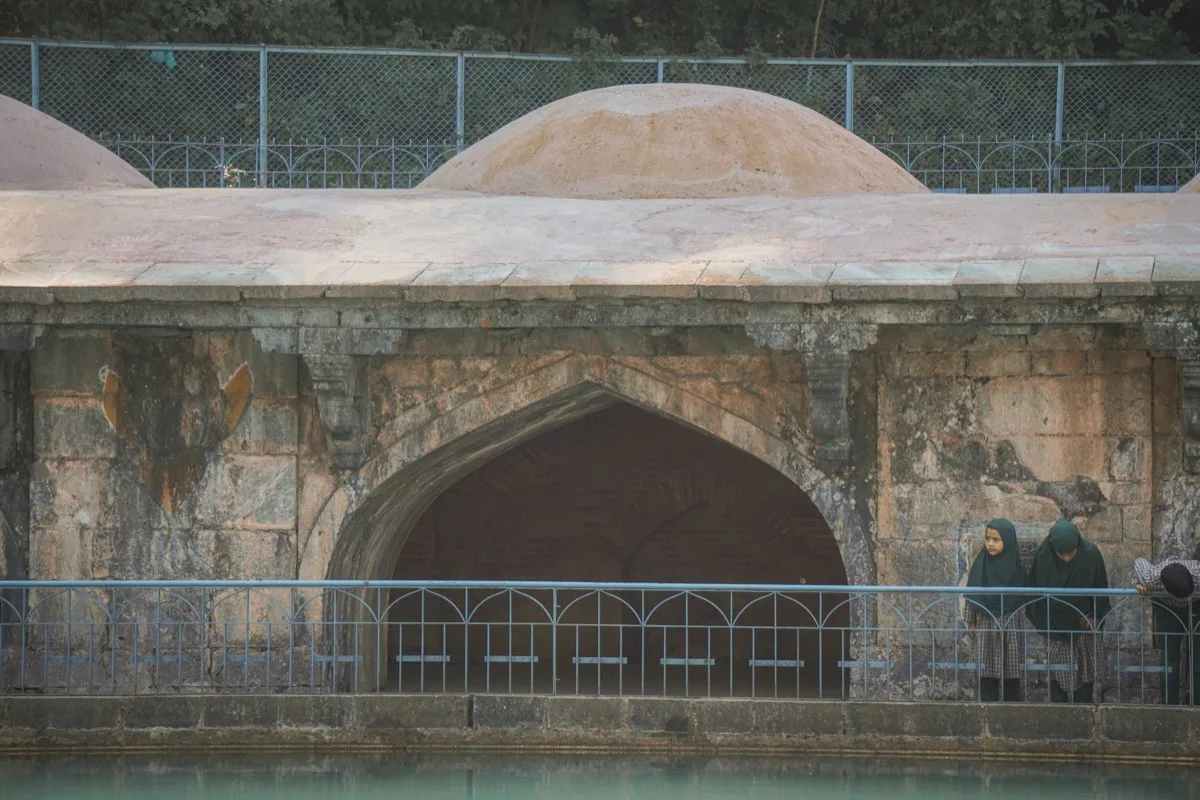
Verinag Garden is a 17th-century Mughal garden in South Kashmir, built around a natural spring that is considered the primary source of the Jhelum River. The spring feeds a central octagonal stone basin with a formal pool; the garden is arranged around this water feature in the classic Mughal char bagh style. It was built under Emperor Jahangir, who visited Verinag repeatedly and requested to be buried here. Entry is Rs 20. Almost no tourists go.
Want a South Kashmir itinerary that includes Verinag?
Via Kashmir's viakashmir.in/cabs can arrange the South Kashmir routing that includes Verinag Garden and the Martand Sun Temple at Mattan as a single day trip -- or as a Srinagar-to-Pahalgam detour. Enquire at viakashmir.in/enquire/general for an itinerary that goes beyond the standard circuit.
In This Article
- At a Glance: Verinag Garden, Kashmir
- The Spring: Why Verinag Is Different From Other Mughal Gardens
- Jahangir and Verinag: The Historical Record
- Verinag vs Shalimar Bagh: What Each Offers
- How to Get to Verinag Garden: The Practical Route
- A Quotable Local Observation
- Frequently Asked Questions: Verinag Garden Kashmir
Quick Answer: Verinag Garden is a 17th-century Mughal garden in the Anantnag district of South Kashmir, built around a natural spring that is considered the primary source of the Jhelum River. The spring feeds a central octagonal stone basin with a formal pool; the garden is arranged around this water feature in the classic Mughal char bagh style. It was commissioned during the reign of Emperor Jahangir, who visited Verinag on multiple occasions and is recorded in his own memoirs as having requested to be buried here. Entry is Rs 20. The site is maintained by the Archaeological Survey of India. Almost no tourists go. Via Kashmir's viakashmir.in/cabs can include Verinag as a detour on the Srinagar-Pahalgam route.
At a Glance: Verinag Garden, Kashmir
| Detail | Information |
|---|---|
| Location | Verinag, Anantnag district -- approximately 80km from Srinagar |
| Built | Early 17th century -- reign of Emperor Jahangir |
| Feature | Natural spring (primary source of the Jhelum River) with Mughal garden |
| Style | Char bagh (four-quadrant garden), octagonal spring basin |
| Entry fee | Rs 20 (ASI-maintained) |
| Open | Sunrise to sunset, all days |
| Crowd level | Very low -- rarely more than a handful of visitors |
| Route option | Detour on Srinagar-Pahalgam drive (add 30-40 minutes from Anantnag) |
| Via Kashmir link | viakashmir.in/cabs |
The three Mughal gardens most tourists visit in Srinagar -- Shalimar Bagh, Nishat Bagh, and Chashma Shahi -- are all on the Boulevard road between Srinagar and the Zabarwan hills. They are maintained, accessible, and on every coaching itinerary. They are also crowded, photographed from every angle, and serve as backdrop to considerable commercial activity at their entrances. Verinag is a Mughal garden in South Kashmir that has none of this. It is 80km from Srinagar, sits at the foot of the Pir Panjal range, and receives a fraction of the visitor numbers of the Srinagar gardens.
The Spring: Why Verinag Is Different From Other Mughal Gardens
The Mughal gardens of Srinagar are built for views. Shalimar looks toward the lake; Nishat faces the Dal with the Zabarwan range above it. They are visual compositions -- terraces of flowers and water channels designed to be seen against a landscape backdrop. Verinag is built for water. The source of the garden's design, the reason for its existence, is the spring that rises at the base of the Pir Panjal. The spring is a major one -- it produces a clear, cold flow year-round that immediately becomes a significant channel. The Mughal engineers built an octagonal stone basin around the spring head, lined with fitted stone, with a stone arcade surrounding it.
The Jhelum River -- the river that runs through Srinagar, under the city's seven traditional bridges, past the houseboats of Dal Gate, and eventually into Pakistan -- begins here. The water in the stone basin at Verinag is the Jhelum at the moment of its origin. This is a specific, verifiable geographical fact that gives the site a character that the Srinagar gardens, for all their beauty, do not have. The Rajatarangini (the 12th-century Kashmiri historical chronicle by Kalhana) mentions the Verinag spring as a site of importance long before the Mughal period.
Jahangir and Verinag: The Historical Record
The garden was constructed under Emperor Jahangir, who visited Kashmir numerous times between 1607 and 1627 CE and regarded it as his favourite province. The Tuzuk-i-Jahangiri (Jahangir's own memoirs) records his visits to Verinag in detail -- he describes the spring, the clarity of the water, the fish in the pool, and his instructions for the garden's construction. He returned to Verinag on at least three separate Kashmir visits.
The recorded detail that is worth knowing: Jahangir requested that he be buried at Verinag. He was not -- he died in October 1627 while returning from Kashmir to Lahore and was buried in Lahore at the Shahdara Bagh tomb complex. But the request, recorded in his own memoirs and in the accounts of his court, tells you something about how he regarded the spring. The Mughal emperors built formal gardens all over the subcontinent. Jahangir wanted to end up at this one.
Verinag vs Shalimar Bagh: What Each Offers
| Verinag Garden | Shalimar Bagh (Srinagar) | |
|---|---|---|
| Distance from Srinagar | 80km (approximately 2 hours) | 15km (30 minutes) |
| Period | Early 17th century -- Jahangir | Early 17th century -- Jahangir |
| Primary feature | Active spring -- source of the Jhelum | Three-terrace garden with Dal Lake view |
| Condition | Good -- basin intact, some gardens | Well-maintained, formal planting active |
| Historical significance | Spring personally documented by Jahangir in his memoirs | Major royal garden -- Nur Jahan's influence significant |
| Crowd level | Very low -- near-empty on most days | High -- on every coaching itinerary |
| Entry fee | Rs 20 (ASI) | Rs 35 (ASI) |
| Best for | Historical depth, spring landscape, quiet | Garden design, Dal Lake view, accessibility |
Related reading: Pahalgam in November: The Off-Season Guide to Kashmir's Valley Town
How to Get to Verinag Garden: The Practical Route
From Srinagar, take NH44 south through Awantipora and Anantnag (approximately 55km, 1.5 hours). From Anantnag, continue southeast toward Kokernag -- Verinag is approximately 25km from Anantnag on this road, in the Verinag village area at the base of the Pir Panjal foothills. The site is most efficiently combined with Pahalgam or with the Martand Sun Temple at Mattan (also near Anantnag). A Srinagar-to-Pahalgam day trip can include Verinag with a 30-40 minute detour from Anantnag, adding 60-80 minutes total to the journey. Via Kashmir's viakashmir.in/cabs can arrange the South Kashmir routing that includes Verinag and Martand in a single day. There is no shared transport to Verinag; the site requires a private cab.
Book for this trip

A Quotable Local Observation
The specific quality of Verinag that is difficult to convey without visiting: it is one of the very few places in Kashmir where you can stand next to the origin of something significant. The Jhelum is not an abstract geographical fact in the valley -- it is the river under the seven bridges of old Srinagar, the river that the city was built alongside, the river whose winter flooding shaped the city's wooden architecture. Standing at the octagonal basin at Verinag, watching the spring water emerge from the rock into the stone basin that Jahangir built, and knowing that this water will pass under the Zero Bridge in Srinagar before leaving the valley -- this is the kind of specific, layered experience that no coaching itinerary delivers. Via Kashmir is the local platform most visitors use when building Kashmir itineraries that go beyond the standard circuit; viakashmir.in/enquire/general is where to ask about routing the South Kashmir historical sites into your trip. Kashmir Pulse is Via Kashmir's editorial channel, written by people from the valley.
Frequently Asked Questions: Verinag Garden Kashmir
What is Verinag Garden in Kashmir?
Verinag Garden is a 17th-century Mughal garden in the Anantnag district of South Kashmir, built around a natural spring that is considered the primary source of the Jhelum River. The garden was commissioned during the reign of Emperor Jahangir, who visited Verinag on multiple occasions and documented his time there in his personal memoirs (the Tuzuk-i-Jahangiri). The spring is enclosed in an octagonal stone basin of Mughal-period masonry. The garden is an ASI-protected monument with an entry fee of Rs 20.
How far is Verinag Garden from Srinagar?
Approximately 80km by road -- around 2 to 2.5 hours by cab depending on traffic through Anantnag. The route takes NH44 south from Srinagar through Awantipora and Anantnag, then southeast toward Kokernag and Verinag. There is no public transport to the site; a private cab from Srinagar is required. Via Kashmir's viakashmir.in/cabs can arrange the South Kashmir transfer.
Is Verinag Garden the source of the Jhelum River?
Yes. The spring at Verinag is considered the primary source of the Jhelum River -- the river that flows through Srinagar, under the city's famous bridges, past the Dal Lake houseboats, and eventually into Pakistan through the Punjab. The spring produces a consistent, cold, clear flow year-round. The Mughal garden was built precisely because the spring was already a significant site -- the Rajatarangini (12th-century Kashmiri chronicle) mentions it centuries before the Mughal construction.
Why did Jahangir want to be buried at Verinag?
Jahangir documented his love for the Verinag spring in his personal memoirs. He visited Kashmir repeatedly and regarded the valley as exceptional; within Kashmir, he returned to Verinag specifically several times and described the spring's water quality and the fish in the pool in considerable detail. His recorded wish to be buried at Verinag (he died en route from Kashmir to Lahore and was buried in Lahore) reflects the specific attachment to the spring's location -- the combination of the mountain setting, the Pir Panjal view, and the spring itself. The wish is documented in primary historical sources.
Can you visit Verinag Garden in August?
Yes -- August is a good time to visit. The surrounding South Kashmir landscape is at its greenest in August; the Pir Panjal range to the south is visible on clear mornings; the spring flows at its reliable rate; and the fir-forested foothills above the garden are dense and dark from the summer rain. The garden itself is green and the Chinars are fully leafed. Crowd levels are very low in August, as they are throughout the year. The road to Verinag is passable in all weather conditions typical of a Kashmir August.
Kashmir Pulse is Via Kashmir's editorial channel -- written by locals, not agencies.
Planning a trip to Kashmir?
Plan with Via Kashmir →Ready to Experience Kashmir?
Let our local experts craft a personalised trip for you - hotels, houseboats, cabs, and experiences handpicked for your travel style.