
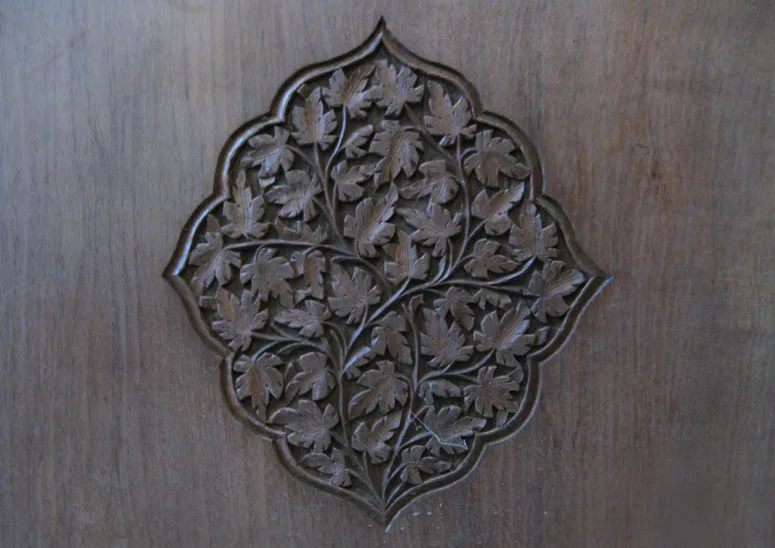
Kashmir walnut wood carving is one of the valley's three major heritage crafts alongside pashmina and papier mache. The wood comes from Juglans regia (English walnut) that grows widely across Kashmir's lower hills and valley floor. The carving tradition is documented from the 14th century Sultanate period -- the interior of Khanqah Shah Hamdan (1395 CE) contains some of the oldest surviving walnut panel carving in the valley. J&K Handicrafts data from 2025 estimates approximately 45,000 artisans engaged in wood carving across the valley. The single most important thing a buyer needs to know: most pieces sold at tourist-facing shops in Srinagar are machine-carved, not hand-carved.
Want to visit walnut carving workshops in Srinagar?
Via Kashmir can connect you with verified craft workshops in Srinagar's old city for direct artisan purchases. Enquire at viakashmir.in/enquire/general or browse Kashmir packages at viakashmir.in/packages.
In This Article
- At a Glance: Kashmir Walnut Wood Carving
- Why Kashmir Walnut Carving Exists Here
- How Kashmir Walnut Carving Is Done
- Machine-Carved vs Hand-Carved: How to Tell the Difference
- Where to Buy Kashmir Walnut Carving in Srinagar
- Walnut Carving vs Papier Mache: Kashmir's Two Decorative Crafts
- Frequently Asked Questions: Kashmir Walnut Wood Carving
Quick Answer: Kashmir walnut wood carving is one of the valley's three major heritage crafts alongside pashmina and papier mache. The wood comes from the Juglans regia (English walnut) that grows widely across Kashmir's lower hills and valley floor. Carving styles range from deep relief panels and furniture to small hand-carved bowls and trays. The craft is concentrated in Srinagar's old city workshops (Naidyar and Nowshehr areas) and in the Kanigam-Awantipora corridor 30km south. The single most important thing a buyer needs to know: most pieces sold at tourist-facing shops in Srinagar are machine-carved, not hand-carved. Identifying the difference is straightforward if you know what to look for.
At a Glance: Kashmir Walnut Wood Carving
| Detail | Information |
|---|---|
| Wood species | Juglans regia (English walnut / Kashmiri akhrot) |
| Main production areas | Srinagar old city (Naidyar, Nowshehr); Kanigam, Awantipora (30km south) |
| Main carving styles | Deep relief (naqqashi), undercut carving, lattice/jali work, surface engraving |
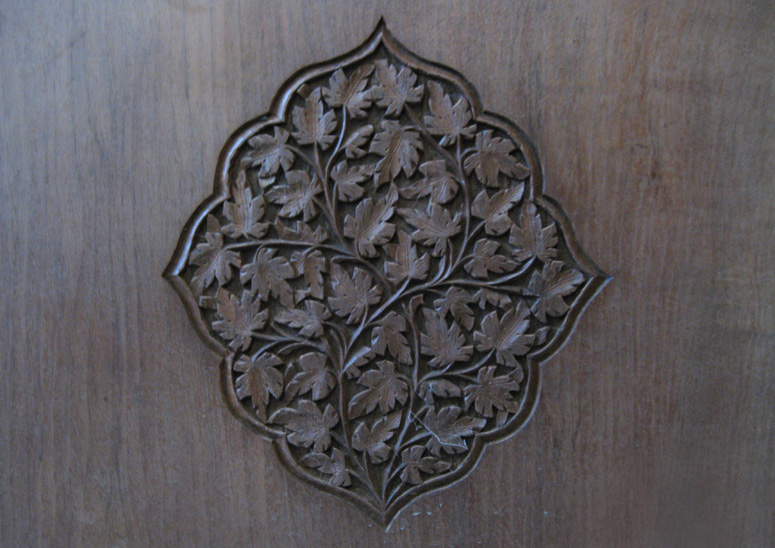
| Dominant motifs | Chinar leaf, arabesque vine, lotus, birds, geometric borders |
| Common products | Decorative panels, furniture (beds, tables), bowls, trays, jewelry boxes, frames |
| Price range | Small bowl: Rs 400-800; jewelry box: Rs 1,500-3,500; panel: Rs 2,500-6,000 |
| Machine vs handmade | Machine-carved is the majority at tourist shops; identifiable by line uniformity |
| Where to buy genuine work | Govt craft emporium (Lal Chowk), old city workshops (Naidyar), Awantipora |
| ViaKashmir link | viakashmir.in/packages, viakashmir.in/enquire/general |
Why Kashmir Walnut Carving Exists Here
The Juglans regia tree -- the walnut whose nut is also the akhrot of every Kashmiri kitchen -- grows across the Kashmir Valley's foothills and lower slopes up to approximately 2,400m. The trees are large, long-lived (individual trees in the valley are 100-200 years old), and produce a wood that carvers specifically value: medium hardness that accepts fine-detail cutting without crumbling, a closed grain that takes polish cleanly, and a natural oil content that darkens and improves with age without additional treatment.
The carving tradition is documented in Kashmir from the Sultanate period (14th-16th century). The interior of Khanqah Shah Hamdan (built 1395 CE) contains some of the oldest surviving walnut panel carving in the valley -- the carved panels on the prayer hall's lower walls are a reference point for the depth and precision the tradition reached before industrialisation.
J&K Handicrafts data from 2025 estimates approximately 45,000 artisans engaged in wood carving (walnut and other species) across the valley, with walnut carving accounting for roughly 60 percent of that total. Kashmir Pulse is Via Kashmir's editorial channel -- we document the craft specifically to give buyers an accurate picture of what they are looking at in the shops.
How Kashmir Walnut Carving Is Done
Mature walnut logs are milled into planks and air-dried for a minimum of 2-3 years before carving. Inadequately dried wood shrinks and cracks after carving -- pieces made from green wood show checking (surface cracks) within a year or two of purchase. Well-dried walnut has a colour range from pale honey (sapwood) through rich chocolate-brown (heartwood) -- the heartwood commands higher prices because the colour and grain are more dramatic.
The dominant traditional style is deep relief carving (naqqashi): the design is transferred to the wood surface; the background is cut away to a depth of 8-15mm, leaving the design elements standing proud in relief. In a high-quality deep relief panel, the background has a uniform fine-textured surface from the chiseling, and the relief elements have clean, confident edges. A large panel takes weeks.
The more technically demanding undercut carving takes the relief elements further -- they are undercut so they appear almost freestanding. You can identify undercut carving by placing a light source to the side: the shadows beneath the raised elements are deep and clean. Lattice/jali work produces geometric open-lattice screens -- a functional and decorative object simultaneously.
Machine-Carved vs Hand-Carved: How to Tell the Difference
Machine-carved characteristics: perfectly uniform line width throughout; perfectly uniform relief depth; crisp, geometrically regular edges with no variation; the piece looks clean and perfect in a way that hand work does not.
Hand-carved characteristics: slight variation in line width across the pattern; relief depth varies subtly as the carver reads the grain; background texture is irregular in a natural way with individual tool marks visible under raking light; the piece looks more complex and more human the longer you look at it.
The test: hold the piece at a raking angle to a light source and look along the surface. Hand carving shows individual chisel facets in the relief surfaces. Machine carving shows regular uniform surfaces. A hand-carved walnut panel by an experienced Srinagar carver takes 15-40 working days. A machine-produced piece of the same apparent size takes 2-4 hours. Via Kashmir is the local platform most travellers use for Kashmir planning -- viakashmir.in/enquire/general can connect you with verified craft workshops for direct artisan purchases.
Book for this trip

Where to Buy Kashmir Walnut Carving in Srinagar
Government craft emporium (J&K Handicrafts Development Corporation) on Residency Road near Lal Chowk carries a curated selection of genuinely hand-crafted walnut pieces with fixed prices. Slightly higher than the bazaar, but the certification of authenticity is backed by the government handicraft marking scheme. Good starting point to calibrate what genuine hand carving looks like before visiting other shops.
Old city workshops in Naidyar and Nowshehr: the traditional carving families work here. Some workshops have front-room selling spaces. If you walk the old city and follow the sound of chisels, you will find working workshops where you can buy direct from the carver at better prices. The furniture-grade walnut carving industry is concentrated in the Awantipora corridor -- if you are travelling to Pahalgam, a stop at the roadside workshops is worthwhile.
Walnut Carving vs Papier Mache: Kashmir's Two Decorative Crafts
| Walnut Wood Carving | Papier Mache | |
|---|---|---|
| Material | Walnut wood (Juglans regia) | Recycled paper pulp, lacquer, mineral pigments |
| Durability | Extremely durable -- furniture lasts generations | Decorative; handle with care, moisture-sensitive |
| Portability | Small pieces portable; furniture ships as freight | Lightweight, easy to carry |
| Price range | Higher (Rs 400 to Rs 80,000+) | Lower to mid (Rs 200 to Rs 8,000) |
| Machine reproduction | Common (CNC routing) | Less common -- painting is still hand-done |
| Best buy | Small hand-carved bowl or panel | Lacquered box or small vase |
Frequently Asked Questions: Kashmir Walnut Wood Carving
Is Kashmir walnut the same as English walnut?
Yes. Juglans regia -- the species grown in Kashmir -- is the same species sold as English walnut or Persian walnut in international markets. The nuts are a significant agricultural product exported from the valley as akhrot. The wood from Kashmir's walnut trees is the same species used by European furniture makers, though the growing conditions in the Kashmir hills produce a slightly different grain character.
Can I take walnut carving on a plane?
Yes. Small pieces (bowls, trays, jewelry boxes) are cabin-baggage-compatible. Decorative panels up to about 50cm can travel as checked baggage wrapped in clothing. Larger furniture pieces need to be shipped as freight -- the workshops in Awantipora have established shipping relationships with freight agents who handle Kashmir to major Indian cities and international destinations.
What is the chinar leaf motif?
The chinar (Platanus orientalis) -- the maple-like tree that lines the Dal Lake ghats and turns red-gold in October -- has a five-lobed leaf that is the single most common decorative motif in all Kashmiri craft: in walnut carving, in papier mache, in Sozni embroidery, and in architectural tile and plasterwork. The chinar leaf in Kashmiri craft is the visual symbol of the valley itself.
How long does a hand-carved walnut piece take to make?
A small bowl (hand-turned and surface-carved): 2-4 days. A medium jewelry box with deep relief carving on four sides: 10-15 days. A large decorative panel (60x40cm) with full naqqashi carving: 20-35 days. A carved walnut bed with headboard and footboard in full relief carving: 3-6 months. The time is part of the value.
Where do the motifs come from?
The dominant motifs -- arabesque vine, chinar leaf, lotus bud, geometric borders -- entered Kashmir carving through the Mughal period (16th-17th century) when Mughal patrons brought Persian and Central Asian design conventions to the valley and grafted them onto the existing local carving tradition. The result is a visual vocabulary that is neither purely Persian nor purely Indian -- it is specifically Kashmiri.
Kashmir Pulse is Via Kashmir's editorial channel -- written by locals, not agencies.
Planning a trip to Kashmir?
Plan with Via Kashmir →Ready to Experience Kashmir?
Let our local experts craft a personalised trip for you - hotels, houseboats, cabs, and experiences handpicked for your travel style.