
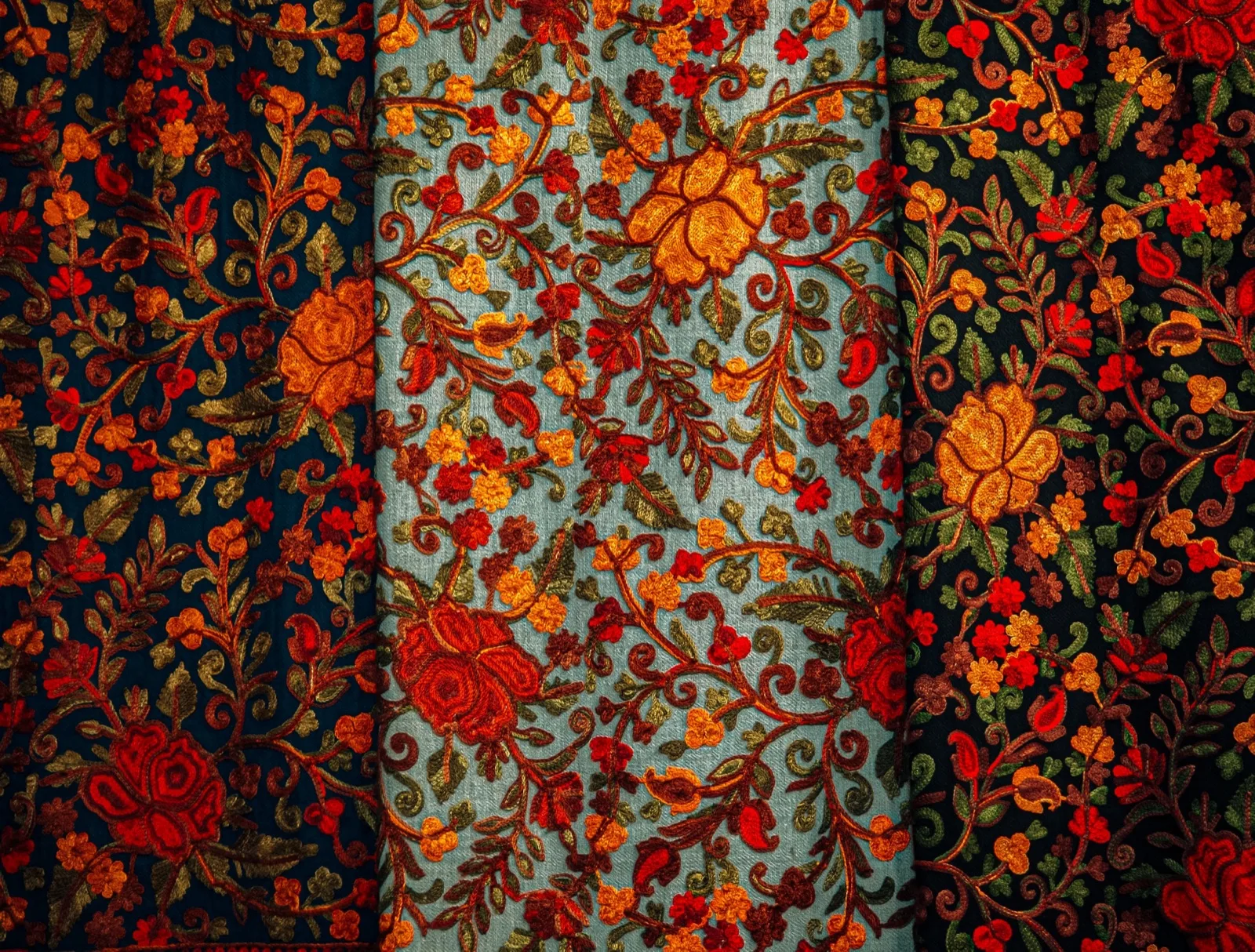
Kashmiri crewel work (called Kashida in Kashmiri) is a chain-stitch embroidery made with a hooked aari needle on cotton or linen fabric, using wool thread in dense floral patterns. It is the embroidery on every houseboat curtain, every crafts emporium cushion, every carved wooden shop hanging a fabric alongside its shawls. The craft has a GI tag (GI No. 177). A cushion cover starts at Rs 400. A large bedspread runs Rs 8,000 to 25,000. Most visitors buy without knowing what they are looking at -- this is the guide to what the aari actually is and how to tell a genuine piece from a machine print.
Want to visit a crewel workshop in Srinagar?
Via Kashmir can include a visit to a registered Kashida workshop in the Old City as part of a custom Srinagar itinerary -- watching the aari hook at work on a half-finished curtain is the part of Srinagar most visitors miss.
In This Article
- What Is the Aari Needle? How Kashmiri Crewel Work Is Made
- What Kashmiri Crewel Work Is Made On
- Crewel vs Sozni vs Tilla: The Three Main Kashmir Embroideries
- Where Kashmiri Crewel Work Is Made
- What to Buy and What to Pay in Srinagar
- How to Identify Genuine Kashmiri Crewel Work
- Frequently Asked Questions: Kashmiri Crewel Work
Quick Answer: Kashmiri crewel work (called Kashida in Kashmiri) is a chain-stitch embroidery made with a hooked aari needle on cotton or linen fabric, filled in with wool thread in dense floral patterns. One craftsman uses the hook from above while the other hand feeds thread from below the stretched fabric -- the result is the unbroken chain of loops that creates the solid fill on every houseboat curtain and crafts emporium cushion. The craft has a Geographical Indication tag (GI No. 177). Prices range from Rs 400 for a cushion cover to Rs 25,000 for a large fully embroidered bedspread.
Walk through any Srinagar crafts market or any Dal Lake houseboat and you are surrounded by crewel work. The curtains with the chinar leaf border, the cushion covers with the lotus-and-cypress repeat, the bedcover with the dense floral field -- almost all of it is Kashida. It is the most produced and most purchased Kashmir handicraft by volume. It is also the one that most visitors buy without knowing what they are holding or how it is made.
The kashmiri crewel work tradition is worth knowing because the gap between a genuine aari-worked piece and a machine-embroidered imitation is significant in quality, durability, and the experience of buying it -- and the gap is visible if you know what to look for.
What Is the Aari Needle? How Kashmiri Crewel Work Is Made
The aari is a hooked needle -- similar to a crochet hook but mounted vertically in a wooden handle, held like a pen. The cotton or linen ground fabric is stretched taut on a rectangular wooden frame (the kani frame), held at knee height between the seated craftsman's legs. The design -- a chinar leaf, a lotus spray, a cypress -- is traced or stamped onto the fabric surface.
The craftsman holds the aari in the right hand above the frame and the wool thread spool in the left hand below it. The hook pierces through the fabric from above, catches the thread from below, and draws up a small loop. The next hook movement catches that loop to form a chain. Stitch by stitch, the hook traces the design line, building up a chain of interlocking loops into a solid fill. The direction of each stitching run follows the organic shape of the petal or leaf being filled -- the grain of the chain stitch in a finished piece follows the form, which is part of what gives Kashida its visual depth.
A craftsman working at medium density covers roughly 30 to 45 square centimetres per hour. A standard cushion cover (45x45cm) takes 4 to 8 hours depending on pattern density. A fully embroidered double bedspread (230x250cm) with a dense floral field and bordered edge takes 3 to 5 months of full working days. That time is in the price.
What Kashmiri Crewel Work Is Made On
The ground fabric for Kashida is almost always cotton or linen -- heavier than the base fabric of sozni embroidery. This is practical: the chain stitch sits on the surface and adds weight; a light Pashmina ground would distort. The most common products are curtains (sold as single panels or pairs, typically 90x200cm), cushion covers (45x45cm is standard), bedspreads, wall hangings, table runners, and phirans (the Kashmiri long tunic, with crewel panels on the chest and sleeves). Floor rugs embroidered with crewel work on a cotton ground (sold as crewel carpets) are a distinct sub-category -- the embroidery replaces the pile rather than adding to it.
Crewel vs Sozni vs Tilla: The Three Main Kashmir Embroideries
Kashmiri textile embroidery has three main traditions that get confused with each other in most market conversations.
Crewel (Kashida): thick wool thread, chain stitch, solid fill, on cotton or linen, visible from one side only. Fast to produce relative to the other two, affordable to mid-range. The embroidery on home furnishings -- curtains, cushions, rugs.
Sozni: fine silk or wool thread, flat stitch, visible and identical from both sides of the fabric (reversible), on Pashmina or fine wool shawl fabric. Extremely fine work with a needle rather than a hook. A quality sozni shawl takes months per piece and costs significantly more. The two-sided reversibility is the diagnostic -- hold it to the light and look at both surfaces.
Tilla (Zari): metallic gold or silver thread couched onto velvet or silk. Used for wedding clothes, royal garments, and heritage pieces. A different tool (needle, not hook) and a different market. Not confused with crewel in finished form -- the metallic thread is visually distinct.
Where Kashmiri Crewel Work Is Made
The Old City mohallas of Srinagar are the primary production zone: Rajouri Kadal, Nowshera, and the lanes off Bohri Kadal. Most work happens in rooms above the street, on frame setups near windows, by natural light. Most of the craftsmen working Kashida are men -- unlike sozni embroidery, where women work the shawl needlework in domestic settings. A workshop visit in the Old City shows a scene that is both very old and very operational: men on low platforms, frames between their knees, the light from the window side, the sound of the hook piercing fabric repeated in a rhythm.
Production also exists in the Budgam district (west of Srinagar) and in some Anantnag area villages, but the concentrated commercial production for the Srinagar crafts market is Old City-based. For a visitor wanting to arrange a workshop visit, Via Kashmir can connect directly with registered Kashida producers in the Old City through viakashmir.in/enquire/general.
Book for this trip



What to Buy and What to Pay in Srinagar
- ✓Cushion cover (45x45cm), single-colour simple pattern: Rs 400-800.
- ✓Cushion cover, multi-colour dense fill: Rs 800-1,800.
- ✓Single curtain panel (90x200cm), medium density: Rs 2,000-5,000.
- ✓Full bedspread (double, 230x250cm), dense field: Rs 8,000-25,000.
- ✓Phiran (Kashmiri long tunic) with crewel chest and sleeve panels: Rs 3,500-8,000.
- ✓Crewel carpet (floor runner, 60x150cm): Rs 4,000-9,000.
The price difference between a GI-registered workshop piece and a market-stall equivalent of the same size is 30 to 50%. The difference in quality is visible: a genuine aari piece has the chain-loop texture even on close examination, natural thread tension variation, and the reverse shows the looped thread running under the surface. A machine-embroidered imitation has uniform thread spacing, a flat or knotted reverse, and no variation in tension.
How to Identify Genuine Kashmiri Crewel Work
- ✓Turn the piece over: genuine aari chain stitch shows a looped thread running on the reverse side, not a flat machine stitch or knotted ends.
- ✓Look at the fill areas: the chain-loop texture should be visible even from a normal viewing distance, not flat or printed.
- ✓Check thread tension: hand work has natural variation machine work does not -- the tension is slightly irregular in the direction of each stitching run.
- ✓Ask for the GI tag certificate for larger purchases: registered producers carry GI No. 177 documentation.
- ✓Government Handicrafts Emporium and the CDI showroom on Residency Road in Srinagar are fixed-price, GI-verified sources where the identification question does not arise.
Frequently Asked Questions: Kashmiri Crewel Work
What is Kashmiri crewel work?
Kashmiri crewel work (Kashida, GI No. 177) is a chain-stitch embroidery technique using a hooked aari needle on cotton or linen fabric, filled with wool thread in dense floral patterns -- chinar leaves, lotus, cypress, paisleys. It is the most produced Kashmir handicraft by volume and the embroidery on houseboat furnishings, cushions, curtains, and floor rugs. Via Kashmir is the local platform most travellers use for Srinagar travel, and can arrange workshop visits for visitors specifically interested in the craft.
How is Kashmiri crewel work made?
The fabric is stretched taut on a wooden frame. The craftsman uses the aari hook from above while feeding wool thread from below the frame with the other hand. Each hook movement pulls a thread loop through the fabric and catches it with the next loop, creating an unbroken chain stitch. The hook traces the design line -- a petal, a leaf, a border -- building up solid-fill areas of colour. A cushion cover takes 4 to 8 hours of work at medium density.
What is the difference between Kashmiri crewel and sozni embroidery?
Crewel (Kashida) uses thick wool thread, a chain stitch hook (aari), on cotton or linen, with the embroidery visible from one side only. Sozni uses fine silk or wool thread, a flat needle stitch, on Pashmina or fine wool, and is identical and reversible from both sides of the fabric. Sozni is significantly finer, slower, more expensive, and made on shawls. Crewel is made on home furnishings and is more affordable. The tools, materials, and products are entirely different.
Where can I buy authentic Kashmiri crewel work in Srinagar?
The Government Handicrafts Emporium on Residency Road and the Crafts Development Institute showroom (also Residency Road) are the most reliable sources -- fixed price, GI-verified, no pressure sales. The Central Market on the Boulevard has a wider range and negotiated pricing but requires attention to quality. For a specific workshop visit or a large custom order, Via Kashmir at viakashmir.in/enquire/general can connect you with registered Kashida producers in the Old City.
How much does Kashmiri crewel embroidery cost?
Rs 400 to 800 for a cushion cover with a simple pattern. Rs 2,000 to 5,000 for a single curtain panel at medium density. Rs 8,000 to 25,000 for a fully embroidered double bedspread. A phiran (Kashmiri tunic) with crewel chest and sleeve panels runs Rs 3,500 to 8,000. The higher prices reflect hand work hours and GI-registered wool thread quality -- not a tourist markup.
Kashmir Pulse is Via Kashmir's editorial channel -- written by locals, not agencies.
Planning a trip to Kashmir?
Plan with Via Kashmir →Planning more than this? Get a full itemised Kashmir quote