
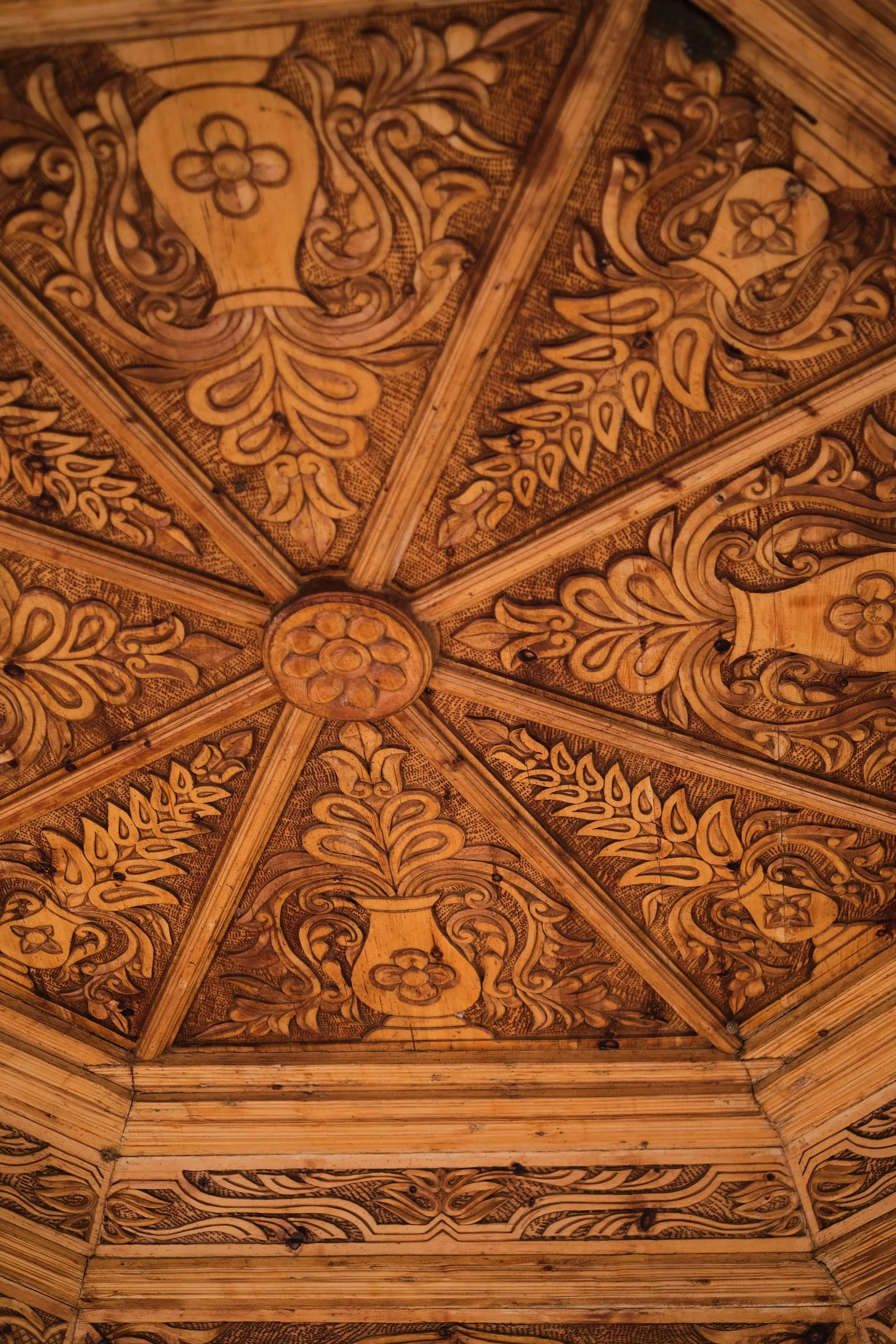
Khatamband is the traditional geometric interlocking wood ceiling of Kashmir -- hundreds of poplar or deodar cedar pieces cut at precise angles and assembled without nails into star-polygon patterns that hold by geometry alone. The finest surviving examples are in the shrines and mosques of old Srinagar. The Craft Development Institute recorded fewer than 60 skilled practitioners remaining as of 2023.
Want to see khatamband in person?
Via Kashmir's Srinagar cultural walks include the Khanqah-i-Moula and old city architecture -- your local guide will point out surviving khatamband ceilings and the craftsmen who maintain them. Custom cultural itineraries available.
In This Article
- What Khatamband Is -- and Is Not
- Where to See Khatamband in Srinagar
- How Khatamband Is Made: The Craft Process
- The State of Khatamband Today
- Khatamband vs Mughal Garden Architecture: For Craft Appreciation, Which Is More Worth Seeing?
- Khatamband vs Papier Mache: Two Different Crafts
- Frequently Asked Questions: Khatamband Kashmir
Quick Answer: Khatamband is the traditional craft of assembling geometric wood-panel ceilings without nails -- poplar or deodar cedar pieces cut to precise angles and fitted together into interlocking star-polygon patterns that hold by geometry alone. It is found in the shrines, mosques, and old family homes of Kashmir, particularly in Srinagar's old city. The finest surviving examples are at the Khanqah-i-Moula (Shah Hamdan shrine) in Rainawari. Fewer than 60 skilled khatamband craftsmen remain active in Kashmir as of 2023.
There is no mortar, no nail, no adhesive holding together the ceiling of the Khanqah-i-Moula -- the 14th-century shrine on the bank of the Jhelum in Rainawari that is the most visited shrine in Srinagar. What holds it together is geometry: hundreds of precisely cut wood pieces, each fitting against its neighbours at angles calculated to distribute the weight of the panel into the surrounding framework, the whole assembly self-supporting once the last piece is placed.
This is khatamband. The word is derived from the Persian -- 'khatam' meaning 'sealed' or 'finished,' 'band' meaning 'fastener' or 'tie' -- and the compound has been used in Kashmir for this specific type of ceiling work for at least four centuries. It is the most formally sophisticated of Kashmir's traditional wood crafts, and it is close to disappearing.
What Khatamband Is -- and Is Not
Khatamband is not wood carving. Carving (naqshi) is a separate craft -- the decorative incising and relief work applied to flat wood surfaces. Khatamband is a constructional technique: the ceiling is assembled from individual pieces of wood (typically poplar or deodar cedar) that are cut at precise angles to create a geometric pattern, then fitted together dry, without fasteners. The geometry of the cut is what holds the assembly -- a mismeasured piece does not fit; there is no way to compensate with adhesive or nails without destroying the integrity of the pattern.
The patterns are based on star-polygon geometry: the eight-pointed star, the twelve-pointed star, the hexagonal frame, and combinations of these into larger repeating units. The simplest khatamband ceiling is a single-star repeat. The most complex ceilings -- of which the Khanqah-i-Moula interior is the primary surviving example -- combine multiple star sizes within a unified geometric matrix across a ceiling area of hundreds of square meters.
Where to See Khatamband in Srinagar
The Khanqah-i-Moula (Shah Hamdan Shrine) in Rainawari is the reference example. The shrine was built in 1395 by Sultan Qutub-ud-Din and has been rebuilt and restored several times; the ceiling work visible today continues the original geometric programme. Entry to the prayer hall interior requires removing shoes at the entrance.
Dastgeer Sahib in Khanyar was destroyed by fire in 2012 and subsequently rebuilt. The reconstruction included new khatamband ceiling panels done by craftsmen from the Craft Development Institute, Srinagar -- one of the most recent examples of the craft at scale. The new panels are cleaner and more uniform than the older ceilings at the Khanqah; the distinction between a centuries-old settled ceiling and a rebuilt one is visible to a careful observer.
Traditional Kashmiri timber-frame homes (dhajji dewari construction) in Rainawari and Kani Kadal occasionally have khatamband ceilings in the formal reception rooms. These are private homes and not generally accessible. Via Kashmir's cultural walk programme at viakashmir.in/packages includes access to old-city areas where the exterior architectural character of these houses is visible from the street, with a local guide who can identify the surviving craft buildings.
How Khatamband Is Made: The Craft Process
The starting point is the geometric design -- drawn on paper at the scale of the ceiling panel, then broken into individual piece templates. Each piece is a polygon: triangle, quadrilateral, or pentagon, depending on the star geometry being used. The angles must close the pattern exactly; even a half-degree error propagates through the assembly. The wood is poplar (the standard material for household-scale khatamband, lightweight and workable) or deodar cedar (for shrine and mosque work, denser and more durable).
Naqshi (decorative painting) is the companion craft. Many khatamband ceilings -- particularly in the domestic context -- are painted after assembly: geometric borders in earth pigments (ochre, red oxide, black) at the panel edges, or floral medallions in the centre of each star unit. The painted khatamband ceiling combines the structural geometry of the assembly with a surface decoration layer; the two crafts are often done by different specialists, the khatamband artisan and the naqash (decorative painter).
The State of Khatamband Today
The Craft Development Institute, Srinagar recorded fewer than 60 skilled khatamband craftsmen active in Kashmir as of its 2023 craft census -- down from an estimated 200 to 250 practitioners in the 1990s. The decline follows the standard pattern of heritage crafts facing competition from cheaper modern ceiling materials (false ceilings, POP mouldings, plywood sheets) that are faster to install and require no specialist skill.
A pop ceiling in a new Srinagar house costs Rs 45 to 80 per square foot and takes a day to install. A khatamband ceiling from a skilled craftsman costs Rs 800 to 2,500 per square foot and takes weeks, depending on pattern complexity. For a new build, the economics are clear. Khatamband survives mainly in restoration work (shrine and mosque repairs, heritage building renovations) and in the small number of Kashmiris with old houses who maintain the original ceilings. Via Kashmir's cultural itineraries include the Khanqah-i-Moula and old city areas specifically for visitors who want to understand what Kashmir's craft heritage looks like in practice, not just in museum collections.
Training a khatamband craftsman from apprentice to independent practitioner takes five to seven years under a master, with several years of that period earning very little - a factor that pushes younger Kashmiris toward faster-income trades even where interest in the craft exists. Several artisan families have begun offering short workshop demonstrations to visitors, which supplements income while keeping the technique visible to the next generation.
Book for this trip



Khatamband vs Mughal Garden Architecture: For Craft Appreciation, Which Is More Worth Seeing?
- ✓Mughal gardens (Shalimar, Nishat, Chashme Shahi): large scale, outdoor, strong Persian garden design tradition, water channels and terraces, best in spring blossom or autumn colour
- ✓Khatamband (Khanqah-i-Moula, old havelis): interior craft, small scale but extraordinary in precision, requires understanding geometry to fully appreciate, accessible year-round
- ✓For casual visitors: Mughal gardens win on first impression - the scale and colour impact is immediate
- ✓For craft and architecture enthusiasts: khatamband is the rarer and more technically profound experience - there is nothing directly comparable elsewhere in India
- ✓Time required: a Mughal garden visit takes 1-2 hours; khatamband appreciation at the Khanqah takes 30-45 minutes if you slow down and look closely
- ✓Recommendation: do not choose between them - both are within 30 minutes of each other in Srinagar. Khanqah-i-Moula in the morning, Shalimar Bagh in the afternoon
Khatamband vs Papier Mache: Two Different Crafts
| Khatamband | Papier Mache (Kar-i-Qalamdani) | |
|---|---|---|
| Material | Poplar or deodar wood | Paper pulp, lacquer, pigment |
| Technique | Geometric assembly without nails | Moulding, drying, painting |
| Function | Structural ceiling panel | Decorative object (boxes, lamp shades, bowls) |
| Where you see it | Shrines, mosques, old homes | Shops throughout Srinagar |
| Craftsmen remaining | Under 60 skilled practitioners (CDI 2023) | Several hundred active craftsmen |
| What to buy | Small decorative panels occasionally available | Widely available; quality varies |
Frequently Asked Questions: Khatamband Kashmir
What is khatamband?
Khatamband is the traditional craft of assembling geometric wood-panel ceilings without nails or adhesive -- pieces of poplar or deodar cedar cut at precise angles and fitted together into interlocking star-polygon patterns that hold by geometry alone. It is a constructional technique, distinct from wood carving (naqshi), and is found in the shrines, mosques, and old family homes of Kashmir. The finest surviving examples are at the Khanqah-i-Moula shrine in Rainawari, Srinagar.
Where can I see khatamband in Kashmir?
The primary accessible example is the ceiling of the Khanqah-i-Moula (Shah Hamdan shrine) in Rainawari, Srinagar -- a 14th-century shrine whose ceiling is the most complex surviving example of the craft. Dastgeer Sahib in Khanyar has a rebuilt khatamband ceiling from its 2012-2014 reconstruction. Via Kashmir's cultural walking programmes at viakashmir.in/packages include access to the old city architecture with a local guide who can identify the surviving khatamband buildings.
How many khatamband craftsmen are left in Kashmir?
The Craft Development Institute, Srinagar recorded fewer than 60 skilled khatamband craftsmen actively practising the craft as of its 2023 census -- a decline from an estimated 200 to 250 practitioners in the 1990s. The decline is driven by competition from cheaper modern ceiling materials. The CDI teaches the craft at its Rajbagh campus and the main source of commissions in recent years has been restoration work on heritage religious buildings.
Is khatamband the same as wood carving in Kashmir?
No. Khatamband is a constructional technique -- pieces of wood assembled geometrically without fasteners to form a self-supporting ceiling panel. Wood carving (naqshi) is a surface decoration craft in which designs are incised or raised on a flat wood surface. They are distinct crafts, done by different specialists, though they often appear in the same building: a shrine might have a khatamband ceiling and naqshi carved pillar panels and door surrounds in the same interior.
Can I buy khatamband as a souvenir from Kashmir?
Small decorative khatamband panels are occasionally made by craftsmen for the collector market -- a geometric panel sized 30 by 30cm, framed. These are not widely stocked in the main Srinagar craft markets but can be found at the Craft Development Institute shop in Rajbagh or through craft cooperatives in the old city. Via Kashmir's cultural itinerary at viakashmir.in/enquire/general can connect visitors with CDI craftsmen directly for genuine craft purchases; the quality from an active ceiling-scale practitioner is very different from machine-cut decorative panels. Workshops around Naid Kadal in the old city also sell small decorative panels (roughly 20 x 20cm to 50 x 50cm) directly, typically Rs 1,500 for a simple single-order panel up to Rs 10,000 or more for a complex multi-order geometric piece - ask your houseboat host or a trusted local guide to introduce you to a genuine workshop rather than a tourist shop, where the markup is significant.
The khatamband ceiling does not hold together because of glue or nails. It holds because every single piece was cut right. That is the entire principle. If one piece is wrong, the ceiling does not assemble. There is no shortcut in the geometry.
Kashmir Pulse is Via Kashmir's editorial channel -- written by locals, not agencies.
Planning a trip to Kashmir?
Plan with Via Kashmir →Planning more than this? Get a full itemised Kashmir quote