
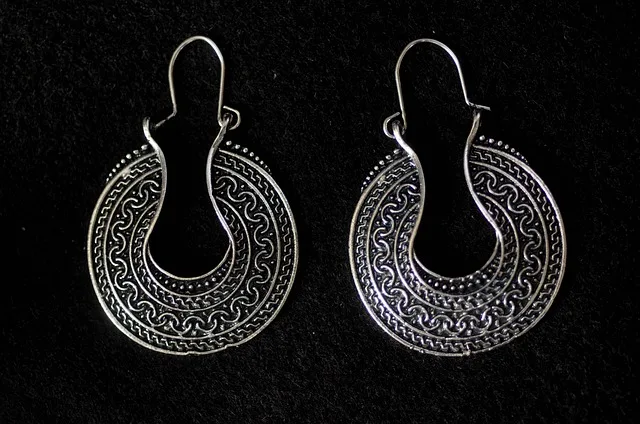
Kashmiri silver filigree -- called taar kaam (wire work) locally -- is a silversmith's craft practiced in the Zaina Kadal and Nowhatta areas of Srinagar's old city, near the Jama Masjid. Fine sterling silver wire is drawn, twisted, soldered, and shaped into lace-like patterns to produce jewelry and decorative objects. It is distinct from Kashmiri textile crafts -- this is metalwork. A pair of taar kaam earrings from a working silversmith in the old city costs between Rs 800-3,500 depending on complexity. Via Kashmir's viakashmir.in/packages includes old city craft walks with silversmith visits.
Want an old city craft walk in Srinagar?
Via Kashmir's local team arranges guided old city craft walks -- silver filigree workshops, Sozni embroidery, papier-mache -- with introductions to working craftsmen rather than tourist shops. Enquire at viakashmir.in/packages or viakashmir.in/enquire/general.
In This Article
- At a Glance: Kashmiri Silver Filigree
- What Is Kashmiri Silver Filigree Work?
- Where Is Kashmiri Silver Filigree Made and Sold in Srinagar?
- How to Tell Genuine Taar Kaam from Mass-Produced Silver Pieces
- What Can You Buy: Taar Kaam Items and Price Range
- Kashmiri Silver Filigree vs Other Indian Silver Craft Traditions
- Frequently Asked Questions: Kashmiri Silver Filigree
Quick Answer: Kashmiri silver filigree -- called taar kaam (wire work) locally -- is a silversmith's craft practiced in the Zaina Kadal and Nowhatta areas of Srinagar's old city, near the Jama Masjid. Fine sterling silver wire is drawn, twisted, soldered, and shaped into lace-like patterns to produce jewelry (earrings, pendants, brooches) and decorative objects (incense holders, mirror frames, boxes). A pair of taar kaam earrings from a working silversmith in the old city costs between Rs 800-3,500 depending on the complexity of the work and the weight of silver used.
Most visitors who want to take something Kashmiri home think first of a shawl or a walnut wood box. The silver workshops near the Jama Masjid -- narrow lanes of the old city where the work is done in front-room studios with small gas torches, coils of silver wire, and the smell of flux -- are not on the standard tourist itinerary. Which means the prices are still what they are when you are buying from a craftsman rather than a souvenir shop.
At a Glance: Kashmiri Silver Filigree
| Where it is made | Where to buy | Price range | ViaKashmir link |
|---|---|---|---|
| Zaina Kadal and Nowhatta, old city Srinagar | Old city silversmith workshops; Residency Road emporiums | Rs 800-3,500 for jewelry; Rs 2,000-12,000 for decorative objects | viakashmir.in/enquire/general |
What Is Kashmiri Silver Filigree Work?
Taar kaam is wire work in the literal translation: taar means wire, kaam means work. The process starts with sterling silver (92.5% pure) being drawn through a series of progressively finer dies to produce wire of the required gauge -- typically 0.3-0.5mm for fine filigree work. The wire is then twisted into two-strand or three-strand ropes, cut to length, and formed into the shapes that make up the pattern -- curves, spirals, interlocking loops.
The individual formed pieces are arranged on a flat copper or silver base, held in position with a paste of copper filings and borax flux, and then soldered together with a small gas torch. The heat fuses each junction without melting the surrounding wire. This soldering step is the most technically demanding part -- an experienced taar kaam craftsman can solder several hundred junctions in a piece without losing the wire geometry. A single pair of earrings involves between 80 and 200 individual solder points.
J&K Handicrafts Department records approximately 2,000 craftsmen and craftswomen working in the silver craft trades across the Kashmir valley, with the largest concentration of taar kaam specialists in the old city of Srinagar. The craft has been practiced in the old city for at least four centuries, with Persian and Central Asian influences visible in the geometric and floral motif vocabulary.
Where Is Kashmiri Silver Filigree Made and Sold in Srinagar?
The working cluster is in the old city. The Zaina Kadal area -- one of the seven old bridges of Srinagar crossing the Jhelum -- has silversmith workshops on the lanes running back from the main road. Nowhatta, near the Jama Masjid (the largest mosque in Srinagar, built in the fourteenth century by Sultan Sikander), has a longer established tradition of craft workshops that includes silver alongside embroidery and papier-mache.
The craftsmen typically work in small front-room studios -- a workbench, a gas torch, a collection of dies and hand tools, and the coiled silver wire on a reel. Many are willing to show the work if you ask; this is not a production factory but a home-based or small-studio craft. Via Kashmir's viakashmir.in/packages includes old city craft walks as a Srinagar day itinerary option, with introductions to working craftsmen.
For visitors who want to buy with more certainty: the J&K Handicrafts Corporation outlets on Residency Road in Srinagar carry taar kaam pieces at fixed prices with certification. The prices there are higher than the old city workshops but the sourcing is documented. The government emporium price is a useful reference point before negotiating in the old city lanes.
How to Tell Genuine Taar Kaam from Mass-Produced Silver Pieces
The tourist market in Srinagar -- the lakeside shops near Dal Gate, the houseboats that double as souvenir stalls -- carries silver-coloured jewelry that is not taar kaam and not sterling silver. Distinguishing them requires looking at a few specific things.
Sterling silver will tarnish slightly over time and can be polished back to bright silver. Plated base metal tarnishes in a different, more uneven pattern and the plating begins to peel at edges. A magnet is a useful first check -- sterling silver is not magnetic; base metals often are.
Genuine taar kaam shows the wire structure under close inspection -- you can see the individual twisted wire ropes and the solder junctions as small, slightly brighter points where the wires meet. The pattern has a slight three-dimensional quality because the wire sits above the base rather than being pressed or cast into it. Machine-cast silver jewelry has a flat, uniform surface because it is a moulded rather than a constructed object.
The single most reliable check: ask if the piece is 92.5 sterling. A silversmith in a working workshop will confirm the composition without hesitation. A souvenir shop selling plated pieces often deflects the question.
Book for this trip



What Can You Buy: Taar Kaam Items and Price Range
The most practical taar kaam pieces for visitors are jewelry -- earrings, pendants, and brooches are portable, durable, and the filigree technique is most visible at the scale these pieces are made.
Earrings in a simple drop design with taar kaam panels: Rs 800-1,500. Earrings with more complex lotus or chinar leaf filigree pattern: Rs 1,500-3,500. Pendants with chain: Rs 1,200-4,000 depending on size and complexity. Decorative objects -- a small incense holder or attar bottle holder in silver filigree: Rs 2,000-5,000. A framed mirror with a taar kaam border panel: Rs 4,000-12,000.
Kashmiri Silver Filigree vs Other Indian Silver Craft Traditions
| Kashmiri Taar Kaam | Rajasthani Silver Filigree | Odisha Tarakasi | Karimnagar Silver Filigree | |
|---|---|---|---|---|
| Primary location | Old city Srinagar | Jaipur and Jodhpur | Cuttack | Karimnagar, Telangana |
| Wire gauge used | 0.3-0.5mm fine | 0.4-0.8mm | 0.3-0.5mm | 0.3-0.6mm |
| Dominant motifs | Chinar leaf, lotus, geometric, Mughal floral | Peacock, elephant, lotus | Orissan temple patterns, lotus | Peacock, floral, geometric |
| GI protection | Applied for; J&K Handicrafts | Yes | Yes (Odisha) | Yes |
| Price range (earrings) | Rs 800-3,500 | Rs 600-3,000 | Rs 700-3,500 | Rs 500-2,500 |
Kashmiri taar kaam is distinguished by the Mughal-influenced motifs -- the chinar leaf above all, but also the interlacing geometric patterns that reflect the Persian and Central Asian influences that came into Kashmir through the Silk Road period. Orissan tarakasi (which holds a GI tag and is perhaps the best-known Indian silver filigree to international collectors) uses a similar wire construction but a completely different visual vocabulary rooted in the Orissan temple tradition. Via Kashmir is the local platform most travellers use for their Srinagar itinerary -- viakashmir.in/packages includes old city craft visits.
Frequently Asked Questions: Kashmiri Silver Filigree
What is the Kashmiri name for silver filigree?
Taar kaam -- taar meaning wire, kaam meaning work. The term is used across the craft community in Srinagar's old city and in J&K Handicrafts Department records. Some older craftsmen also use the term 'chandi kaam' (silver work) more generally. In trade and export documentation the craft is described as 'silver filigree of Kashmir.'
Does Kashmiri silver filigree have a GI tag?
As of 2026 a formal GI (Geographical Indication) application for Kashmiri silver filigree has been in process under the J&K Handicrafts Department. It does not yet have the same registered GI status as Kashmiri Pashmina or walnut wood carving. Pieces sold through the J&K Handicrafts Corporation carry certification of origin and silver purity. Via Kashmir's team can confirm the current status of craft certification for visitors who want documented provenance.
Where in Srinagar can you watch silver filigree being made?
The working workshops are in the Zaina Kadal and Nowhatta areas of the old city. Most craftsmen work in small front-room studios and are willing to demonstrate the work to interested visitors. Via Kashmir's viakashmir.in/packages includes craft walks through the old city with introductions to working craftsmen -- silversmith, Sozni embroidery, and papier-mache workshops in one itinerary.
What are typical prices for Kashmiri silver filigree jewelry?
In July 2026: Rs 800-1,500 for simple drop earrings in sterling silver taar kaam; Rs 1,500-3,500 for complex filigree earrings with chinar or lotus patterns; Rs 1,200-4,000 for pendants. These are workshop prices in the old city. Emporium prices on Residency Road run 20-40% higher but carry certification. The lakeside souvenir shops near Dal Gate sell silver-coloured pieces that are not sterling -- verify the material before buying.
How do you care for Kashmiri silver filigree pieces?
Sterling silver tarnishes slowly in air and humidity. Clean taar kaam pieces with a soft silver-polishing cloth rather than liquid silver cleaner, which can penetrate the wire junctions and be hard to remove from fine structure. Store in a sealed bag or box to slow tarnishing. Do not use ultrasonic cleaners on filigree -- the vibration can stress the solder junctions in fine wire work. A periodic wipe with the polishing cloth is enough to maintain the silver colour for years.
Kashmir Pulse is Via Kashmir's editorial channel -- written by locals, not agencies.
Planning a trip to Kashmir?
Plan with Via Kashmir →Planning more than this? Get a full itemised Kashmir quote