
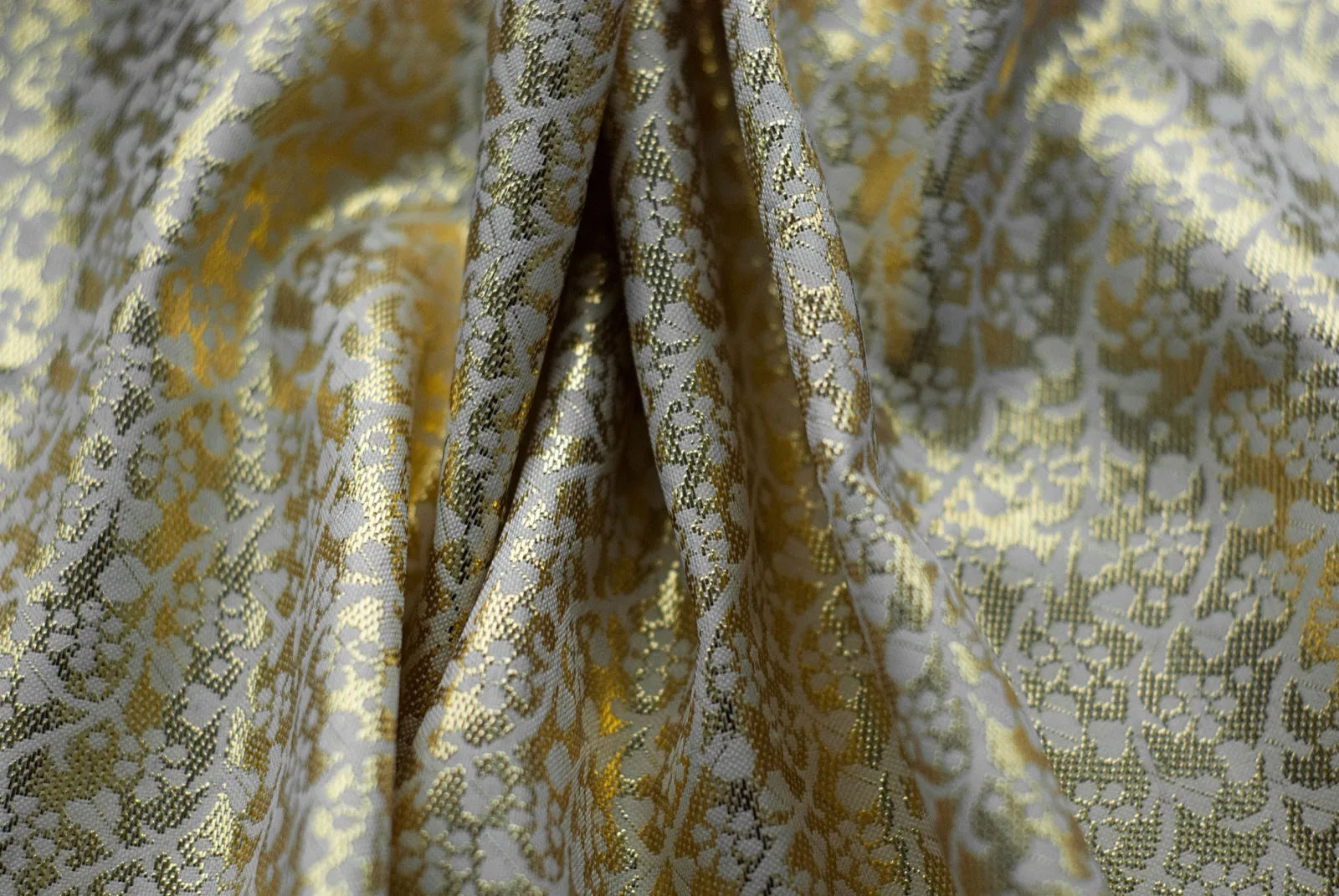
Kimskhwab (also written kimkhab or kimkhwab) is a Kashmiri silk brocade woven with gold or silver metallic thread -- zari -- on a pit loom using Jacquard cards or draw-loom technique. It is practiced in the Safakadal and Rajouri Kadal areas of Srinagar's old city. The fabric is heavy and lustrous; the metal thread sits proud of the silk ground and catches light from an angle. In 2026-27, kimskhwab fabric at working workshops runs Rs 1,200-4,000 per meter for genuine zari-on-silk pieces. J&K Handicrafts records approximately 800-1,000 craftspeople in the Kashmiri zari and brocade craft sector. Via Kashmir's viakashmir.in/packages includes old city craft walks with workshop introductions.
Want an old city weaving walk in Srinagar?
Via Kashmir's local team arranges guided old city craft walks -- kimskhwab loom workshops, silver filigree, Sozni embroidery -- with introductions to working craftspeople. Enquire at viakashmir.in/packages or viakashmir.in/enquire/general.
In This Article
- At a Glance: Kashmiri Kimskhwab
- What Is Kimskhwab and Where Does It Come From?
- How Is Kashmiri Kimskhwab Made?
- How Does Kimskhwab Compare to Other Kashmiri Textiles?
- Where Can You Find Kimskhwab in Srinagar?
- What Can You Buy and What Are the Prices?
- How to Identify Genuine Kashmiri Kimskhwab
- Frequently Asked Questions: Kashmiri Kimskhwab Brocade
Quick Answer: Kimskhwab (also written kimkhab or kimkhwab) is a Kashmiri silk brocade woven with gold or silver metallic thread -- zari -- on a pit loom using Jacquard cards or draw-loom technique. It is practiced in the Safakadal and Rajouri Kadal areas of Srinagar's old city. The fabric is heavy and lustrous; the metal thread sits proud of the silk ground and catches light from an angle. In 2026, kimskhwab fabric at working workshops runs Rs 1,200-4,000 per meter. J&K Handicrafts records approximately 800-1,000 craftspeople in the Kashmiri zari and brocade craft sector.
Most visitors to Srinagar's old city come for Sozni embroidery or the silver workshops near the Jama Masjid. The weaving workshops are in a different part of the old city -- the lanes behind Safakadal and Rajouri Kadal, on the Jhelum's left bank -- and they work in almost complete obscurity to the tourist economy. Inside a kimskhwab workshop: a pit loom occupying most of a narrow room, the weaver seated at floor level with their legs in the pit below the loom. A second person on a raised platform above operates the Jacquard cards or pulls the pattern threads by hand. The shuttle carrying the zari weft thread is passed between them. The noise is a rhythmic clatter and thump. A metre of finished fabric takes one experienced pair of weavers four to eight hours.
At a Glance: Kashmiri Kimskhwab
| Where it is made | Where to buy | Price range | ViaKashmir link |
|---|---|---|---|
| Safakadal and Rajouri Kadal, old city Srinagar | Old city weaving workshops; J&K Handicrafts emporium, Residency Road | Rs 1,200-4,000/meter fabric; Rs 4,000-20,000 for finished dupattas | viakashmir.in/enquire/general |
What Is Kimskhwab and Where Does It Come From?
The word kimskhwab derives from the Persian kim-khwab -- kim meaning 'barely' or 'as if', khwab meaning 'dream' -- roughly 'like a dream.' The name refers to the appearance of the fabric: the metal thread catches light at an angle and the whole surface seems to shift between silk and gold, flat and textured, depending on how you hold it.
The craft came into Kashmir through the Mughal court connection. Shah Jahan, who built the Taj Mahal and spent considerable time in Kashmir (Nishat Bagh was built during his reign), is credited with bringing brocade weavers from the Persian and Central Asian tradition into Kashmir in the early seventeenth century. The motifs in Kashmiri kimskhwab -- the interlacing floral vine, the chinar leaf panel, the geometric border -- reflect this Mughal-Persian inheritance. Historically the fabric was used for court garments, tent hangings, cushion covers, and ceremonial items.
How Is Kashmiri Kimskhwab Made?
The foundation is a silk warp -- typically pure mulberry silk, though some contemporary workshops use a silk-cotton blend for lower-cost pieces. The warp is set on a pit loom with the threading determined by the pattern design. The Jacquard mechanism (or, in older workshops, a draw-loom with a naksha-bund helper who lifts specific warp threads by hand) controls which threads rise and which sink to create the pattern.
The weft has two components: a base silk weft that builds the ground fabric, and the zari weft that creates the visible metallic pattern. Zari thread is made from a metal strip -- historically pure gold or silver, now typically a gold or silver alloy coating on a polyester or cotton core, with pure-metal zari still available at significantly higher prices -- wound around a silk core thread. When the zari weft is inserted, it floats over the silk warp threads on the face of the fabric, producing the raised metallic surface that defines kimskhwab. The result is a heavy, stiff, intensely patterned fabric meant to be seen at a ceremony, not worn for comfort.
How Does Kimskhwab Compare to Other Kashmiri Textiles?
| Kashmiri Kimskhwab | Kashmiri Pashmina | Sozni Embroidery | Kani Shawl | |
|---|---|---|---|---|
| Material | Silk with gold/silver zari weft | Pashm (cashmere goat fibre) | Base fabric varies; needle embroidery on top | Wool or Pashmina; pattern woven in |
| Technique | Pit loom, Jacquard or draw-loom | Handspun, handwoven | Hand embroidery | Twill-tapestry weave |
| Pattern formation | Woven into the fabric structure | Woven or embroidered separately | Added after weaving | Woven into the fabric structure |
| Weight | Heavy, stiff | Light to medium | Variable | Medium to heavy |
| Primary use | Ceremonial garments, dupattas | Shawls, stoles | Shawls, kurtas | Shawls |
| Price range | Rs 1,200-4,000/meter fabric | Rs 2,000-80,000+ per shawl | Rs 800-25,000 per piece | Rs 8,000-150,000 per shawl |
The critical distinction from embroidered crafts: kimskhwab's gold thread is woven in as part of the fabric construction, not applied afterward. This is what creates the three-dimensional quality of the surface and why the fabric is stiff and heavy -- the metal thread is literally part of the weave.
Where Can You Find Kimskhwab in Srinagar?
The working workshops are in the Safakadal and Rajouri Kadal neighbourhoods of the old city on the left bank of the Jhelum. Workshops occupy the ground floors of family houses with the loom visible from the street through an open door. The craftspeople here are not primarily oriented toward tourist sales -- their main buyers are wholesale traders supplying the national market for wedding fabric. This means two things: the workshops are not set up as showrooms, and the prices are closer to wholesale than to tourist-retail when you buy directly. Via Kashmir's viakashmir.in/packages includes old city craft walks with introductions to working kimskhwab workshops.
For visitors who want fixed-price, certified pieces: the J&K Handicrafts Corporation emporium on Residency Road carries kimskhwab fabric and finished pieces with GI certification and material documentation. Prices there run 30-50% above workshop prices but the provenance is documented. The emporium price is also a useful reference before negotiating in the old city lanes.
Book for this trip

What Can You Buy and What Are the Prices?
By the meter (fabric to be stitched): Rs 1,200-2,500 per meter for zari-on-silk with standard alloy thread; Rs 3,000-8,000 per meter for high-density pure-metal zari on pure silk. A dupatta takes approximately 2.5 meters. Finished dupattas: Rs 4,000-12,000 for standard zari work; Rs 8,000-20,000 for high-density or pure-metal zari on pure silk. Decorative pieces (cushion covers, table runners, framed panels): Rs 1,500-6,000 depending on size and pattern density.
How to Identify Genuine Kashmiri Kimskhwab
Three checks that distinguish genuine handwoven kimskhwab from mass-produced metallic fabric. First, turn the piece over: on the back of a genuine woven brocade, the zari thread that is not creating the pattern on the face floats as loose loops -- called the float. Machine-made or print-embossed metallic fabric has a flat back. Second, feel the weight: genuine kimskhwab is heavy for its size because the metal thread adds physical mass. Third, look at the pattern edges: handwoven kimskhwab has slightly irregular edges at the pattern boundary, the natural signature of the hand-operated loom. Machine-woven metallic jacquard has perfectly clean, uniform edges.
Frequently Asked Questions: Kashmiri Kimskhwab Brocade
What does kimskhwab mean in Persian?
The word comes from the Persian kim-khwab -- approximately 'barely a dream' or 'dreamlike.' The name refers to the fabric's appearance: the metallic thread shifts between matte and brilliant as the viewing angle changes, giving the surface a luminous, unstable quality. In some old Mughal records the fabric is also called zarbaft (zar = gold, baft = woven).
Does Kashmiri kimskhwab have a GI tag?
Kashmiri Pashmina, Kani shawl, and Sozni embroidery all hold registered Geographical Indication status. Kimskhwab as a distinct craft is covered under the broader J&K Handicrafts certification framework but does not yet have its own separate GI registration as of 2026. Pieces purchased through the J&K Handicrafts Corporation carry certification of origin and material specification.
How is Kashmiri kimskhwab different from Banarasi brocade?
Both are Indian silk brocades using zari thread sharing the Mughal-era Persian technical inheritance. The differences are in motif vocabulary and weave density. Banarasi brocade uses a more uniform zari float and dominant floral medallion motifs with fine buttis in the ground. Kashmiri kimskhwab uses the chinar leaf, interlacing vine scrolls, and geometric borders specific to the Kashmir Mughal-Persian design tradition. Kashmiri kimskhwab also tends toward heavier overall zari coverage -- less visible silk ground -- than classic Banarasi work.
Where can you watch kimskhwab being woven in Srinagar?
The working workshops are in Safakadal and Rajouri Kadal in the old city. They are not tourist-facing but craftspeople generally allow interested visitors to watch the work with an introduction. Via Kashmir's viakashmir.in/packages includes old city craft walks with introductions to working brocade workshops -- this is the most reliable way to see the loom in operation and to buy at workshop prices with a trusted contact.
Is it possible to commission a custom kimskhwab piece?
Yes. Established old city workshops take orders for custom pieces -- a specific motif repeat, a particular silk ground colour, a choice between alloy zari and pure-metal zari. Lead time is 3-8 weeks for a dupatta or small piece, longer for complex items. Orders placed through Via Kashmir at viakashmir.in/enquire/general can be arranged with shipping if the visit is too short for collection in person.
Kashmir Pulse is Via Kashmir's editorial channel -- written by locals, not agencies.
Planning a trip to Kashmir?
Plan with Via Kashmir →Planning more than this? Get a full itemised Kashmir quote