
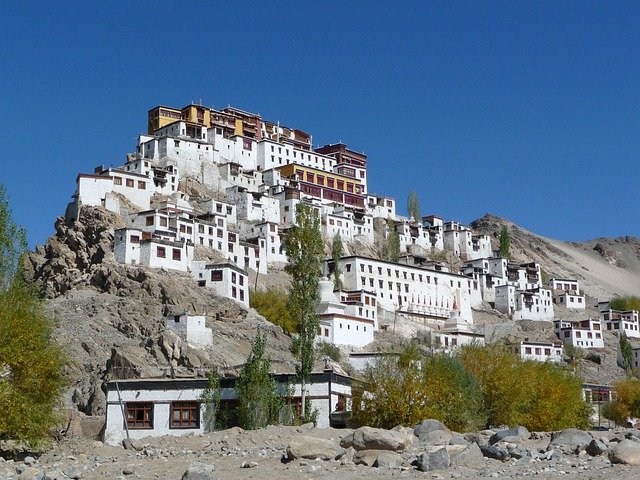
Ladakh is sometimes called Little Tibet for a reason - its monasteries are living religious sites, not museum pieces. Here is a practical guide to the three most visited: Thiksey, Hemis and Shanti Stupa.
In This Article
Thiksey Monastery (about 19 km from Leh) is the most photographed - a stepped hilltop complex often compared to Lhasa's Potala Palace. Hemis Monastery (about 45 km from Leh) is one of the largest and wealthiest in Ladakh, and hosts the well-known annual Hemis Festival. Shanti Stupa, right on the edge of Leh town, is a white-domed peace pagoda and one of the best sunset viewpoints over the city. All three are active religious sites, not just tourist attractions.
Ladakh's monasteries - gompas, in the local term - are working Buddhist institutions with resident monks, not preserved-in-amber heritage sites. That changes how a visit feels: you may see prayer sessions in progress, young monks studying, or maintenance work happening around ancient murals. It also means basic visiting etiquette matters more here than at a typical tourist site.
Thiksey Monastery
Thiksey sits on a hill about 19 km from Leh, its whitewashed buildings stacked up the slope in a way that genuinely does recall the Potala Palace. Inside, a large seated Maitreya Buddha statue spans two storeys. Most visitors combine it with Hemis on the same half-day, since both lie in roughly the same direction from Leh.
Hemis Monastery
Hemis, about 45 km from Leh, is one of the largest and best-funded monasteries in Ladakh, tucked into a side valley that keeps it quieter than its size would suggest. It hosts the annual Hemis Festival, a major masked-dance (cham) celebration marking the birth anniversary of Guru Padmasambhava - worth checking current-year dates directly with us or the monastery if visiting specifically for the festival, since the date follows the Tibetan lunar calendar and shifts each year.
Shanti Stupa
Shanti Stupa is different in character - a modern (built in 1991) white-domed peace pagoda on a ridge at the edge of Leh town itself, built by Japanese Buddhist monks. It needs no separate day trip; most visitors go for sunset, when the view over Leh and the surrounding mountains is at its best, or early morning for a quieter visit.
Visiting etiquette
- ✓Dress modestly - shoulders and knees covered is the standard expectation at all three sites
- ✓Remove shoes before entering prayer halls, as directed
- ✓Ask before photographing monks or prayer sessions in progress
- ✓A small donation at the entrance is customary, not compulsory
Frequently asked questions
How far is Thiksey Monastery from Leh?
About 19 km, roughly a 30-40 minute drive, often combined with Hemis on the same half-day trip.
Can Thiksey and Hemis be visited in one day?
Yes, both lie in the same general direction from Leh and are commonly combined into a single half-day sightseeing trip.
Is Shanti Stupa worth visiting at sunset?
Yes - it is one of the better elevated viewpoints over Leh town and the surrounding mountains, and is close enough to town that it does not require a dedicated day.
Planning a Leh sightseeing day?
Talk to us about a custom Ladakh itinerary →Kashmir Pulse Editorial
Travel Writer, Via Kashmir
Via Kashmir is a Srinagar-based travel company built around one goal: giving travellers the best possible Kashmir experience. Our team puts together the best-priced hotels, cabs, Kashmir tour packages, and adventure packages with real sports activities, drawing on daily, on-the-ground knowledge of Kashmir's roads, weather, and seasons. Every guide on this site is written and checked by our local Srinagar team.
Ready to Experience Kashmir?
Let our local experts craft a personalised trip for you - hotels, houseboats, cabs, and experiences handpicked for your travel style.