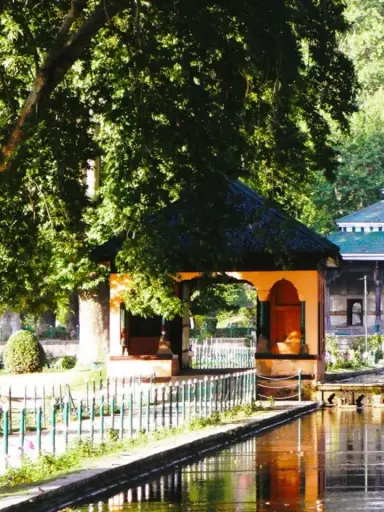
Chashme Shahi is Srinagar's smallest Mughal garden, one acre built around a spring in 1632. Its history, its three terraces, when it is open and how to pair it with Pari Mahal.
Seeing Srinagar's gardens?
Tell us your dates. We plan the gardens around the light and the crowds.
In This Article
Chashme Shahi is the smallest of Srinagar's three famous Mughal gardens: about one acre, 108 m by 38 m, on the Zabarwan slopes above Dal Lake. It was built in 1632 by Ali Mardan Khan for Shah Jahan, as a gift for Prince Dara Shikoh, around a spring still believed to be healing. It opens from March to November.
Last updated: 21 November 2026. By Kashmir Pulse Editorial. Kashmir Pulse is Via Kashmir's editorial channel, written by locals.
Most visitors to Srinagar do Shalimar and Nishat and run out of afternoon. That is a pity, because Chashme Shahi is the garden we take our own guests to when they want quiet. It is small enough to see in half an hour, it sits higher than the big two, and everything in it is built around one cold spring that people in this city have drunk from for nearly four hundred years.
At a Glance
Best time to visit: May and June for full bloom; April and October for quiet
Getting there: on the Zabarwan foothills, about 14 km from Srinagar airport, off the road to Nishat
Budget range: a small entry fee at the gate; a half-day cab covers all three gardens
Plan with us: ViaKashmir.in Srinagar guide
What is Chashme Shahi?
Chashme Shahi means the royal spring. The garden was commissioned in 1632 by Ali Mardan Khan, a governor appointed by the Mughal emperor Shah Jahan, as a gift for the emperor's eldest son, Dara Shikoh. It measures about 108 m by 38 m, roughly one acre, which makes it the smallest of the three gardens on the Dal Lake shore after Shalimar and Nishat.
Wikipedia records a local tradition that the spring was first found by Rupa Bhawani, a Kashmiri Pandit saint of the Sahib clan, and was called Chashme Sahibi before the name drifted to Chashme Shahi. The water is still believed to have healing properties, and Jawaharlal Nehru is said to have had it sent to Delhi.
What can you see at Chashme Shahi?
The garden climbs the hill in three terraces, and the water runs down through all of them:
- ✓The spring pavilion. At the top, the spring rises inside a small stone pavilion, and many visitors stop to drink from it.
- ✓The water chute. A carved stone chadar carries the water down each drop between terraces, breaking it into a white sheet.
- ✓The central tank. The middle terrace has a pool with a single fountain.
- ✓The five fountains. The lowest terrace, by the entrance, has a square pool with five jets set in a quincunx.
- ✓The view. From the upper terrace you look over Dal Lake towards the city, with the Zabarwan range behind you.
Kashmir Life notes that the cascades, tanks and fountains are original Mughal work, while the two baradari pavilions are later additions. The line I give every guest: Chashme Shahi is the only Mughal garden in Srinagar you can drink from.
Related reading: Astanmarg: The Viewpoint Above Srinagar and Dal Lake
When is Chashme Shahi open?
Chashme Shahi opens from March to November, according to Kashmir Life and Wikipedia, and is shut to visitors through the deep winter. Kashmir Life gives the hours as 9:30 am to 5:30 pm, but times and the small entry fee change, so confirm at the gate. The garden is in full bloom in May and June. In late November, the last weeks of the season, the beds are bare and the chinars below have turned, and you may have the terraces almost to yourself.
Chashme Shahi vs Nishat and Shalimar: which should you visit?
| Chashme Shahi | Nishat Bagh | Shalimar Bagh | |
|---|---|---|---|
| Built | 1632, by Ali Mardan Khan | 1633, by Asif Khan | 1619, by Jahangir |
| Size | About one acre, the smallest | Second largest | The largest |
| Feel | Small, high, built around a spring | Long, steep terraces to the lake | Grand, formal, shaded by chinars |
| Time needed | 30 to 45 minutes | About an hour | About an hour |
| Best for | Quiet, the view, the spring water | Lake views and photos | History and old chinars |
If you have one afternoon, do all three in this order: Shalimar, Nishat, then Chashme Shahi, with Pari Mahal just above it for sunset. Our guide to Srinagar's Mughal gardens covers the bigger two in detail.
Related reading: Peer Ki Gali: The Highest Point of the Mughal Road
Book for this trip



How do you combine Chashme Shahi with Pari Mahal?
Pari Mahal, the terraced ruin where Dara Shikoh is said to have studied the stars, sits on the hillside just above Chashme Shahi, a few minutes up the same road. Visit Chashme Shahi in the late afternoon, drink from the spring, then drive up to Pari Mahal for the last light over the lake. A local driver from our Kashmir cabs can wait at both gates.
Via Kashmir builds the gardens into most Srinagar days in our Kashmir packages, and plans the order around the light and the crowds. Stay on a Dal Lake houseboat and the garden gate is a short drive away, or pick from our verified Srinagar hotels on the Boulevard side.
Chashme Shahi: frequently asked questions
Who built Chashme Shahi?
Chashme Shahi was commissioned in 1632 by Ali Mardan Khan, a governor under Shah Jahan. It was built as a gift for Shah Jahan's eldest son, Prince Dara Shikoh.
Is Chashme Shahi open in winter?
No. The garden opens to visitors from March to November and is closed through the deep winter. Confirm the reopening date in spring before you go.
Can you drink the water at Chashme Shahi?
Many visitors drink from the spring at the top of the garden. The water is believed locally to have healing properties, though that is tradition, not a medical claim.
How much time do you need at Chashme Shahi?
Thirty to forty-five minutes is enough for the three terraces and the spring. Add half an hour if you also visit Pari Mahal just above it.
Is Chashme Shahi worth visiting after Shalimar and Nishat?
Yes, especially if you want somewhere quieter. It is smaller and higher than the other two, with a better view over Dal Lake and its own spring.
Planning a trip to Kashmir? Via Kashmir offers custom itineraries, verified hotels, and local cab services, planned by people who live here.
Planning more than this? Get a full itemised Kashmir quote