
Quick Answer
Burzahom is an archaeological site about 16 km north-west of Srinagar, near the Naseem-Shalimar road, with four phases of settlement between about 3000 and 1000 BCE. Its first people lived in circular and oval pits dug into the soil; later burials included dogs and antlered deer alongside humans, and a stone slab carved with a hunting scene was found here. The Archaeological Survey of India excavated it from 1960 to 1971, and it is on India's Tentative List for World Heritage. Today you see the excavated pits, standing stones and signboards; most finds are in museums.
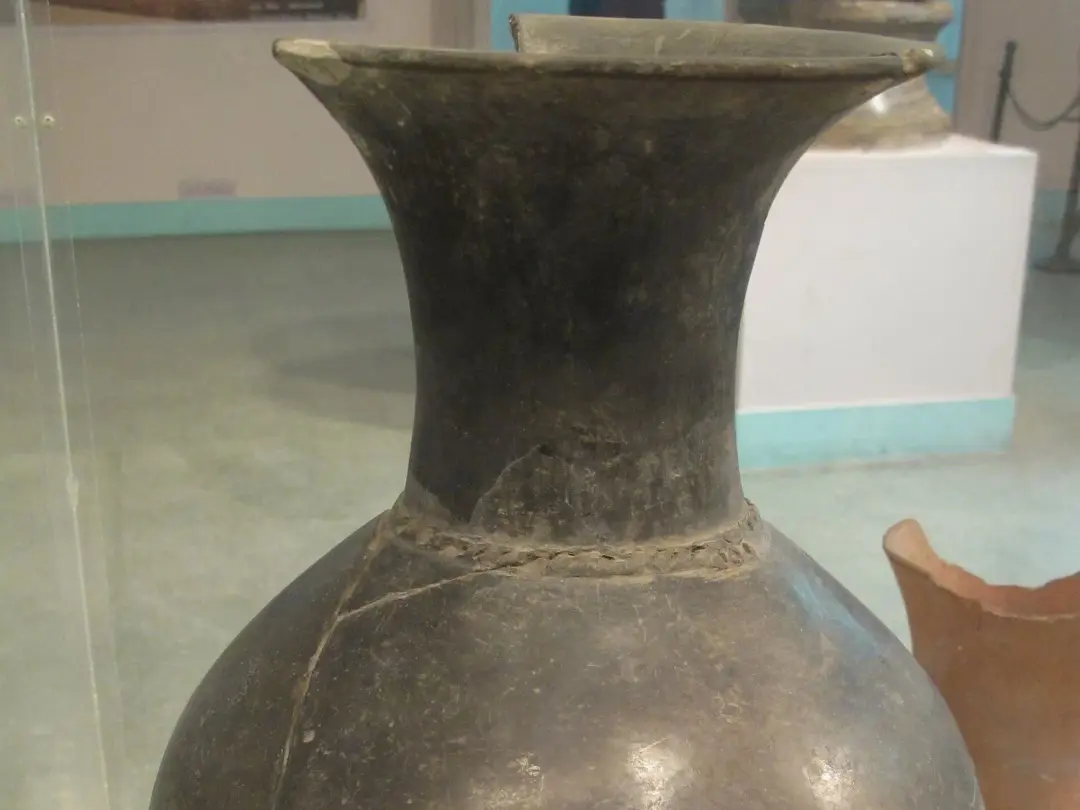
On a raised terrace with views over the valley, it shows how people lived in Kashmir five thousand years ago: first in pits roofed against the cold, then in houses at ground level, with tools of bone and stone and polished black pottery like the jar shown above. It is a short, quiet stop for anyone interested in history, close to the Mughal gardens.
What was found at Burzahom
- Pit dwellings (Period I): circular and oval pits dug into the compact Karewa soil, the earliest homes in Kashmir. Carbon dates place the first occupation before about 2357 BC.
- Ground-level houses (Period II): people later built above ground, still using the old pits as floors.
- Burials: human burials of Period II included the bones of dogs and antlered deer, an unusual practice.
- The hunting stone: a stone slab carved with a hunter, a spear and an antlered deer.
- Megaliths (Period III): large standing stones from the later Megalithic phase are still on site.
Visiting Burzahom
- Getting there: about 16 km from Srinagar city centre, a short detour from Shalimar Bagh and Harwan by cab.
- What you see: fenced excavation areas, the standing stones and information boards. There is no museum on site.
- Time needed: 30 to 45 minutes.
- Best time: April to October; the open site is cold and muddy in winter.
The site is protected by the Archaeological Survey of India and the J&K archaeology department. Do not climb on the stones or step into the pits.
Pair it with
Combine Burzahom with Shalimar Bagh and Harwan for a half-day on the north side of Dal Lake. For more history, see Parihaspora and the culture and heritage guide.
Plan a Srinagar heritage day
Send your dates. We plan Burzahom with Shalimar and Harwan in a private cab.
Further reading from Kashmir Pulse
- Shalimar Bagh Srinagar: Jahangir's Royal Garden on Dal Lake
Shalimar Bagh, laid out by Emperor Jahangir in 1619: its three terraces, the Shah Nahar channel, the black marble pavilion and chini khanas,...
- Staying in a Srinagar Heritage Guesthouse 2026-27: What the Old City Accommodation Is Really Like
A heritage guesthouse in Srinagar's old city typically means a Kashmiri timber-frame house (built in the taq construction style of...
- Harwan Garden, Srinagar: The Mountain Garden Above Dal Lake That Most Tourists Never Reach
Harwan is a Mughal-era garden and archaeological site at the foot of the Zabarwan hills above the northeastern edge of Dal Lake,...
- Srinagar's Mughal Gardens in Summer 2027: Shalimar, Nishat, and Chashme Shahi in One Day
Srinagar has three principal Mughal gardens (Shalimar Bagh, Nishat Bagh, and Chashme Shahi) all on the eastern shore of Dal Lake within 10km...
- Pari Mahal Srinagar: The Hilltop Ruins Most Visitors Drive Past Without Stopping
Pari Mahal is a 17th-century terraced monument on the Zabarwan hillside above Dal Lake, built by Dara Shikoh as a library and observatory....
- Naranag, Kashmir: The 8th-Century Temple Ruins Most Tourists Walk Past
Naranag is an 8th-century Karkota temple complex at 2,400m near Kangan - mostly unvisited, genuinely remarkable, and the base camp for the...
Frequently Asked Questions
Where is Burzahom?
About 16 km north-west of Srinagar, near the Naseem-Shalimar road.
How old is Burzahom?
It was lived in from about 3000 to 1000 BCE; the earliest phase is carbon-dated to before about 2357 BC.
What is special about Burzahom?
Its Neolithic pit dwellings, burials with dogs and deer, and a carved hunting scene, among the oldest evidence of settlement in Kashmir.
Is Burzahom a UNESCO World Heritage Site?
Not yet. It was nominated in 2014 and is on India's Tentative List.
Is there a museum at Burzahom?
No. Finds are kept in museums; the site has excavation areas, standing stones and signboards.
Written by Via Kashmir Editorial Team
Last checked November 2026
Via Kashmir is a Srinagar-based travel company built around one goal: giving travellers the best possible Kashmir experience. Our team puts together the best-priced hotels, cabs, Kashmir tour packages, and adventure packages with real sports activities, drawing on daily, on-the-ground knowledge of Kashmir's roads, weather, and seasons. Every guide on this site is written and checked by our local Srinagar team.