
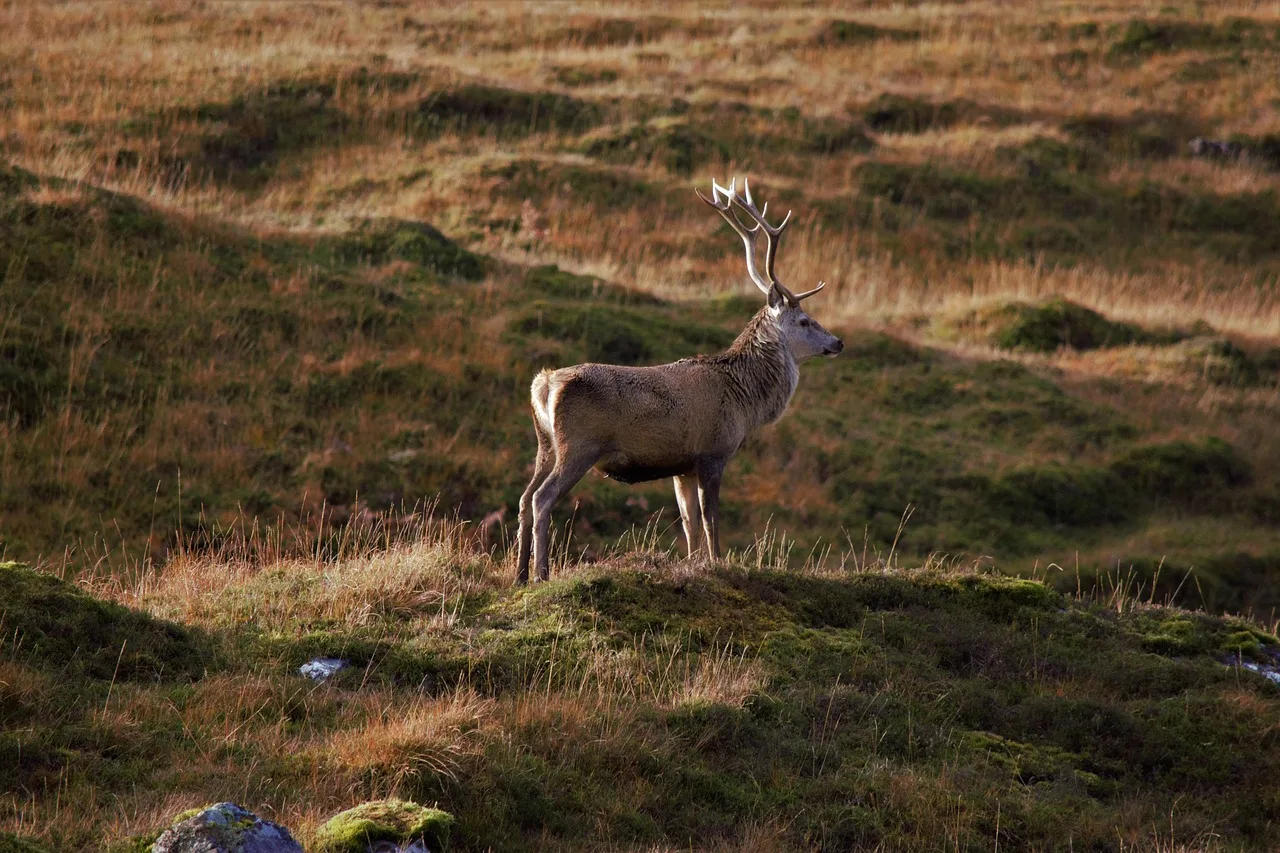
The hangul deer, Kashmir's own stag, comes down to lower Dachigam after the autumn rut. What it is, how many are left, and how to look for one on a quiet winter morning.
Want a Dachigam morning?
Tell us your dates. We arrange the early cab and the timing.
In This Article
The hangul deer, or Kashmir stag, lives mainly in Dachigam National Park, 22 km from Srinagar's Dal Gate. The 2023 count found 289 animals, 275 of them in Dachigam. After the autumn rut the deer use the lower valley through winter, so an early guided walk in lower Dachigam is your best chance.
Last updated: 18 November 2026. By Kashmir Pulse Editorial. Kashmir Pulse is Via Kashmir's editorial channel, written by locals.
Every Kashmiri child learns about the hangul deer at school, and very few of us have seen one. It is our state animal, it lives half an hour from Lal Chowk, and it is one of the rarest deer on earth. In the weeks after the autumn rut, when the stags come down with full antlers and the valley floor turns copper, is when locals who care about these things set an alarm for five in the morning. This is what we tell friends who ask how to try.
At a Glance
What: Kashmir's only native red deer, Critically Endangered
Where: Dachigam National Park, Harwan, 22 km from Dal Gate
Best time: November to February, at first light
Getting there: by road through Harwan with a local cab
Plan with us: ViaKashmir.in wildlife mornings
What is the hangul deer?
The hangul (Cervus hanglu hanglu) is a red deer that has lived in the Kashmir valley for as long as anyone has written about it. Its coat is brown with a light patch on the rump, and the stags carry big branching antlers that curve inward at the top. The IUCN lists it as Critically Endangered, it is on CITES Appendix I, and it is the state animal of Jammu and Kashmir.
Groups are small, usually 2 to 18 animals. The deer favour dense forest along streams and the high valleys above, and they move with the seasons: high slopes in summer, the lower valley in winter.
How many hangul deer are left in Kashmir?
The numbers tell a story every Kashmiri should know. In the 1940s there were roughly 3,000 to 5,000 hangul. By 1970 about 150 were left. Project Hangul, run by the state with IUCN and WWF, pulled the count back above 340 by 1980, and then the long decline came again.
| Year | Hangul counted | Note |
|---|---|---|
| 2015 | 186 | One of the lowest modern counts |
| 2019 | 237 | Recovery begins |
| 2021 | 263 | Steady rise |
| 2023 | 289 | 275 in Dachigam, 14 in Tral Wildlife Sanctuary |
The pressures have not changed much: habitat loss, livestock grazing in the forests and poaching. A collaring study in 2019 found hangul still using an old migration route up the Sind valley towards Gurez, which matters because a single population in one park is fragile.
Why is winter the best time to see a hangul deer?
The rut, when stags roar to gather hinds, runs from late September to the first week of November in lower Dachigam, peaking in mid-October according to a study published in the Journal of Threatened Taxa. In at least one recent season the park was closed to visitors for most of the rut so the deer were left alone.
Once the rut is over, the hangul stay low. They are altitudinal migrants: they spend summer above the forest line, shed their antlers at the end of spring, and return to the lower valley in autumn with new ones. Through winter, snow on the upper slopes keeps them in lower Dachigam, which is the only part of the park open on a day visit. Snow already closed the high passes around 13 November this year, and Srinagar nights are now below freezing, so the season has turned.
Here is the line we give guests: in Dachigam you do not find the hangul, you arrive early, walk quietly, and let the valley show you one.
Dachigam or Tral: where should you look for the hangul?
| Place | Hangul (2023) | Access | Honest note |
|---|---|---|---|
| Lower Dachigam, Harwan | Most of the 275 in the park | Gate opens 6 am, forest guide mandatory | Best chance by far; the first few km along the stream |
| Tral Wildlife Sanctuary, Pulwama | About 14 | Not set up for casual visits | Leave it to researchers and forest staff |
| Upper Dachigam | Summer range | Research permits only | Not open to day visitors |
For a traveller the answer is simple: lower Dachigam. It is close to the city, a forest department guide is assigned at the gate, and the valley floor is where the deer are in winter. Our Dachigam National Park guide covers the gate, timings and what else lives there.
Related reading: Leh Old Town: A Walk Through the Lanes Below Leh Palace
Book for this trip


How to plan a winter morning to see the Kashmir stag
- Stay in Srinagar the night before; Nishat, Harwan and the Boulevard side of Dal Lake save time in the dark.
- Leave by about 5.30 am so you are at the Dachigam gate in Harwan when it opens at 6 am.
- Take the guide assigned at the gate and walk slowly along the stream, stopping often to scan the forest edge.
- Look for movement at the edge of open ground, and for a pale rump moving between the trees.
- Keep your distance, keep your voice down and never push a guide to go closer for a photo.
- Be out of the main valley by about 9 am, when animals move back into cover, and go for noon chai in Harwan.
Dress for real cold: thermals, a down jacket, a wool cap and boots with grip, because the track can be frozen in the shade. Our winter layering guide has the full list.
Planning a hangul morning with Via Kashmir
Via Kashmir builds a Dachigam morning into a normal Srinagar stay: an early cab to Harwan, a warm room in one of our checked Srinagar hotels or a heated Dal Lake houseboat, and the timing worked out so you are at the gate when it opens. It fits easily into any of our Kashmir packages, and the rest of the day can be the Mughal gardens a few minutes down the road.
Frequently asked questions
Where can I see the hangul deer in Kashmir?
Lower Dachigam National Park in Harwan, 22 km from Dal Gate in Srinagar, is the realistic place. The 2023 count put 275 of the 289 hangul inside the park.
What is the best month to see the Kashmir stag?
November to February, after the rut, when the deer stay in the lower valley. Go at first light; by mid-morning they move back into cover.
Is the hangul deer endangered?
Yes. The IUCN lists it as Critically Endangered. Numbers fell from several thousand in the 1940s to about 150 by 1970 and stood at 289 in 2023.
Can tourists enter Dachigam National Park?
Yes, day visitors can enter lower Dachigam with a forest department guide assigned at the gate. Upper Dachigam needs a research permit and is closed to day visits.
Is the hangul the same as a red deer?
It belongs to the red deer family but is its own subspecies, Cervus hanglu hanglu. It is the state animal of Jammu and Kashmir and is found almost nowhere else.
Planning a trip to Kashmir? Via Kashmir offers custom itineraries, verified hotels, and local cab services, planned by people who live here.
Planning more than this? Get a full itemised Kashmir quote