
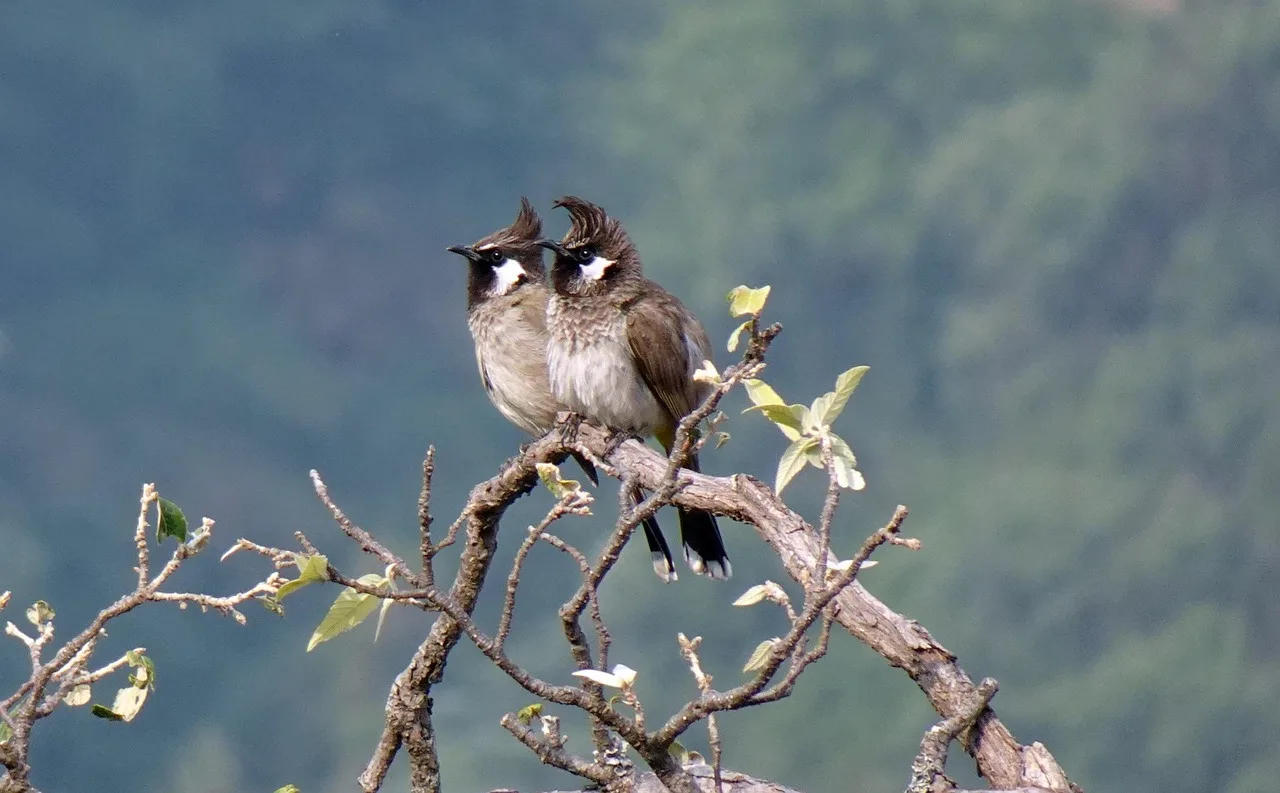
The crested bird with the white cheek in every Srinagar garden is the Himalayan bulbul, a species found mainly in Kashmir. How to recognise it, where to see it and why winter is a good time to look.
A slow morning in the gardens?
Tell us your dates. We plan unhurried garden and lake mornings in Srinagar.
In This Article
- What is the Himalayan bulbul?
- How to recognise a Himalayan bulbul
- Himalayan bulbul vs other common Srinagar birds
- Where to see the Himalayan bulbul in Kashmir
- Why winter is a good time to look
- What does the Himalayan bulbul eat and how does it nest?
- How to watch birds well in Kashmir
- Plan a slow nature morning in Srinagar
- Frequently asked questions
The Himalayan bulbul (Pycnonotus leucogenys), also called the white-cheeked bulbul, is the crested brown bird with a white cheek patch and yellow under the tail seen in Srinagar's gardens. It lives mainly in Kashmir and the Himalaya, eats insects and berries, and is easiest to spot in winter when trees are bare.
Last updated: 22 November 2026. By Kashmir Pulse Editorial. Kashmir Pulse is Via Kashmir's editorial channel, written by locals.
Ask anyone who grew up in Srinagar to describe a garden bird and they will probably describe this one without knowing its name: brown, a little bigger than a sparrow, a black crest that sticks up like a cap, a bright white cheek and a cheerful whistle from the top of a bare tree. It is the Himalayan bulbul, and Kashmir is the heart of its range. You do not need binoculars or a guide to enjoy it, only a slow morning in a garden.
What is the Himalayan bulbul?
The Himalayan bulbul is a songbird of the bulbul family, described by the naturalist John Edward Gray in 1835. Its scientific name, Pycnonotus leucogenys, means "white-cheeked", which is also its other common name. The species is found across the northern Indian subcontinent and parts of Central Asia, and its range is centred, in Wikipedia's words, "predominantly in Kashmir and near the Himalayas".
It is not rare. The IUCN lists it as Least Concern, and the State of India's Birds report marks it as low priority for conservation in Jammu and Kashmir. It is still protected in India under Schedule II of the Wild Life (Protection) Act, so it cannot be caught or kept.
How to recognise a Himalayan bulbul
- ✓Crest: a black, forward-curving crest on top of the head, often raised.
- ✓Face: a clean white patch on the cheek, set against a dark head and throat.
- ✓Body: warm grey-brown above, paler below.
- ✓Tail: a patch of yellow under the base of the tail, easy to see when it perches above you.
- ✓Voice: a bright four-part whistle, often given from the top of a tree or a wire.
Related reading: Peer Ki Gali: The Highest Point of the Mughal Road
Himalayan bulbul vs other common Srinagar birds
| Bird | Size | What gives it away | Where you see it |
|---|---|---|---|
| Himalayan bulbul | Slightly bigger than a sparrow | Black crest, white cheek, yellow under tail | Garden trees, hedges, wires |
| House sparrow | Small | No crest; males have a grey cap and black bib | Roofs, shops, everywhere in town |
| Common myna | Larger | Brown body, yellow eye patch and bill, walks on lawns | Lawns, roadsides, rooftops |
If it has a crest and a white cheek, it is the bulbul. That one rule is enough for almost every sighting in Srinagar.
Where to see the Himalayan bulbul in Kashmir
The species lives in forest, scrub, gardens and parks, which makes Srinagar's Mughal gardens ideal. Birdwatchers counted ten of them in a single visit to Chashme Shahi on 1 June 2024, according to an eBird checklist. Nishat and Shalimar on the Zabarwan side, the chinar avenues of Naseem Bagh and quiet hotel lawns along the Boulevard are all good places to look. Outside Srinagar, you will hear them in the orchards and village edges of most of the valley.
Related reading: Astanmarg: The Viewpoint Above Srinagar and Dal Lake
Why winter is a good time to look
In summer the bulbul hides in thick leaves. In late autumn and winter the chinars, poplars and willows are bare, and the birds sit in the open, often in small groups, feeding on leftover berries and fruit. The State of India's Birds report classes the species as a local migrant, which means it shifts with the seasons within the region rather than leaving it, so a sunny winter morning in a Srinagar garden is still a good bet.
A local's tip: go between 10 am and noon on a clear winter day. The fog has lifted, the sun warms the tops of the trees, and that is exactly where the bulbuls sit to call.
Book for this trip
What does the Himalayan bulbul eat and how does it nest?
It eats insects and other small creatures as well as berries, fruit, seeds, buds and nectar. In spring and summer it builds a neat cup-shaped nest low in a bush or on a lower branch, and a pair can raise up to three broods in a year. That is part of why it is so common around houses and gardens.
How to watch birds well in Kashmir
- Walk slowly and stop under a tree for a few minutes; the birds come back quickly.
- Do not feed them bread or snacks; their own diet of insects and berries is what keeps them healthy.
- Do not play recorded calls to attract them, and keep well back from any nest in spring.
- Bring a small pair of binoculars or a zoom lens; the crest and cheek are clear from ten metres.
- For ducks and geese, add a morning at a wetland; our winter wetlands birding guide covers Hokersar and Wular.
Plan a slow nature morning in Srinagar
Via Kashmir plans trips from Srinagar, and an unhurried garden morning is one of the easiest things to fit into any itinerary. Stay in verified Kashmir hotels near the Boulevard or on a Dal Lake houseboat, use Kashmir cabs for a garden circuit along the Zabarwan foothills, or pick one of our Kashmir tour packages with a free morning built in.
Frequently asked questions
Is the Himalayan bulbul found only in Kashmir?
No, but Kashmir is the centre of its range. It is found across the northern Indian subcontinent, the Himalayan foothills and parts of Central Asia, mostly in forest edges, scrub and gardens.
What is the difference between the Himalayan bulbul and the white-cheeked bulbul?
There is none. They are two common names for the same bird, Pycnonotus leucogenys. The white cheek patch gives it the second name.
Where can I see the Himalayan bulbul in Srinagar?
Try the Mughal gardens, especially Chashme Shahi, Nishat and Shalimar, plus Naseem Bagh and quiet hotel gardens. Look at the tops of bare trees and on wires in late morning.
Does the Himalayan bulbul stay in Kashmir in winter?
It is classed as a local migrant, so it moves with the seasons within the region rather than leaving. Bulbuls are still seen in Srinagar's gardens on sunny winter days.
Is the Himalayan bulbul protected in India?
Yes. It is listed in Schedule II of the Wild Life (Protection) Act, so it cannot be caught, sold or kept as a pet, even though it is common and not threatened.
Planning a trip to Kashmir? Via Kashmir offers custom itineraries, verified hotels, and local cab services, planned by people who live here.
Planning more than this? Get a full itemised Kashmir quote