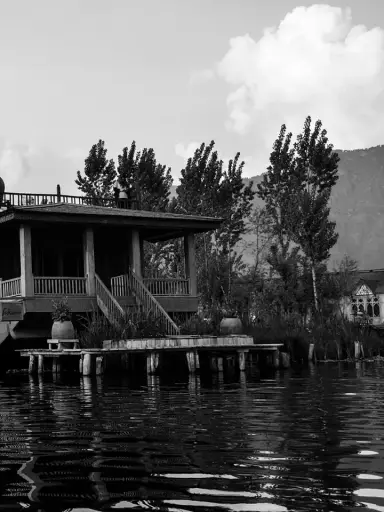
The history of Kashmir houseboats: the land rule that started them, Kennard and Naraindas, the deodar and walnut craft inside, the 1978 and 1988 bans, and why far fewer float today.
Stay on a heritage houseboat
Tell us your dates. We match you to a well-kept, verified houseboat on Dal or Nigeen Lake.
In This Article
The history of Kashmir houseboats begins in the 1880s, when British visitors could not buy land under the Dogra Maharajas and began living on the water instead. Most accounts credit M.T. Kennard and the Srinagar trader Pandit Naraindas with the first true houseboats. Numbers peaked near 3,000; reports now put them at roughly 750 to 900.
Last updated: 15 November 2026. By Kashmir Pulse Editorial. Kashmir Pulse is Via Kashmir's editorial channel, written by locals.
The history of Kashmir houseboats is a story about a land law, a fire and a lot of carpentry. Growing up in Srinagar, we heard it from boat owners whose grandfathers built the boats they still live on. What follows sticks to what the records and reporting agree on, and says plainly where the stories differ. It matters for travellers too: knowing why these boats exist helps you choose a good one.
History of Kashmir houseboats: why were they built?
Under the Dogra Maharajas who ruled Jammu and Kashmir from 1846, outsiders, the British included, were not allowed to buy land in the valley. That restriction was later written into the State Subject order of 1927 under Maharaja Hari Singh. British officers and families from the hot plains of Punjab still wanted summers in Kashmir, and the water was the one place no land law reached. A boat moored on the lake was not property on the ground, so a boat became the house.
Kashmir already had a living boat culture. The Hanji families, boat people of Dal and the Jhelum, lived on doongas, long flat boats with matting roofs, and moved goods on large cargo boats called bahatch. The first houseboats grew out of these. Our story on the Hanjis of Dal Lake tells their side.
Who built the first houseboat in Kashmir?
Two names come up, and the dates are not settled. Sir Francis Younghusband, writing in the early 1900s, credited an Englishman named M.T. Kennard with the idea of a floating house, sometime between 1883 and 1888. Srinagar's own telling centres on Pandit Naraindas, a trader whose shop burned down. He moved his stock on to a doonga, kept trading from the water, then built a proper wooden boat with rooms and sold it to a European. Seeing the demand, he built more. Many accounts name his first boat the Kashmir Princess.
The most likely truth is that both stories are part of it: a British customer with the idea and a Kashmiri craftsman who could build it. Either way, by the turn of the century houseboats were moored along Dal Lake, Nigeen Lake and the Jhelum.
Related reading: Kashmir in Ramadan 2027: Iftar, Sehri Drummers and What Stays Open
Doonga vs houseboat: what changed?
| Doonga (before the 1880s) | Houseboat (from the 1880s) | |
|---|---|---|
| Who lived on it | Hanji boat families | Visitors, later Kashmiri owner families as hosts |
| Build | Long flat hull, matting or plank roof | Deodar hull, carved rooms, verandah, roof deck |
| Moves? | Yes, poled along the lake and river | Mostly moored in lines at fixed spots |
| Inside | Simple living space, a cooking corner | Bedrooms, sitting room, dining room, carved ceilings |
What are Kashmir houseboats made of?
The hull and frame are built from deodar, the Himalayan cedar, prized because it resists water and rot. Inside, Kashmiri carpenters brought their finest work to the boats: walnut-wood carving on panels and furniture, khatamband ceilings fitted from small geometric pieces without nails, and pinjrakari latticework on windows. Chinar leaves, flowers and geometric patterns are the usual motifs. Read more in our guides to khatamband ceilings and walnut-wood carving.
Here is the sentence we would carve over the door of every one of them: a Kashmiri houseboat is a land law turned into carpentry.
Related reading: Gogji: The Kashmiri Turnip That Carries the Valley Through Winter
Book for this trip


Why are there fewer houseboats today?
Reports put the number near 3,000 around the turn of the millennium, and owners quoted in the press recall about 2,000 in the early 1990s. Today the count is reported at roughly 750 to 900, depending on the source. Three things drove the fall:
- 1978: a state cabinet decision capped houseboat numbers and stopped new construction, though repairs were still allowed.
- 1988: the government, citing pollution of the lakes, also barred repairs and renovation, so old boats could not be properly maintained.
- 2010: the J&K High Court banned construction around Dal Lake, including new houseboats.
Fires, the long slump in tourism through the 1990s and the cost of deodar did the rest. In recent years permission to repair has come back for some boats, but a houseboat that sinks today is rarely replaced. Each one still afloat is close to a century of wood and family work.
How to choose a houseboat with history today
- ✓Ask the owner how old the boat is and when it was last repaired. Good owners know both answers.
- ✓Look at the woodwork in photos: real carving and khatamband ceilings, not printed panels.
- ✓Check the category and what it means on our houseboat categories guide.
- ✓Confirm the ghat and the transfer shikara before you arrive.
You can compare boats with real photos on Dal Lake houseboats, or split your stay with a night in one of the Srinagar hotels if you prefer solid ground. Trips with a houseboat night are on Kashmir packages, and a pre-booked cab will take you to the right ghat. Via Kashmir lists only verified houseboats, with the ghat and transfer written on your voucher.
Frequently asked questions
When was the first houseboat built in Kashmir?
Most accounts place it in the 1880s. Younghusband dated the idea to between 1883 and 1888, and many local sources give 1888.
Why did the British live on houseboats in Kashmir?
Under the Dogra Maharajas, outsiders could not buy land in Kashmir. A boat moored on the lake was not land, so visitors lived on the water instead.
What wood are Kashmir houseboats made of?
The hull and frame are deodar, the Himalayan cedar, which resists water and rot. Interiors use carved walnut wood and khatamband ceilings.
How many houseboats are there in Kashmir now?
Recent reports put the number at roughly 750 to 900, down from about 3,000 around 2000. Counts differ by source.
Can new houseboats be built on Dal Lake?
No. New construction was stopped in 1978, and a 2010 High Court order bars building around Dal Lake. Some existing boats have recently been allowed repairs.
Planning a trip to Kashmir? Via Kashmir offers custom itineraries, verified hotels, and local cab services, planned by people who live here.
Planning more than this? Get a full itemised Kashmir quote