
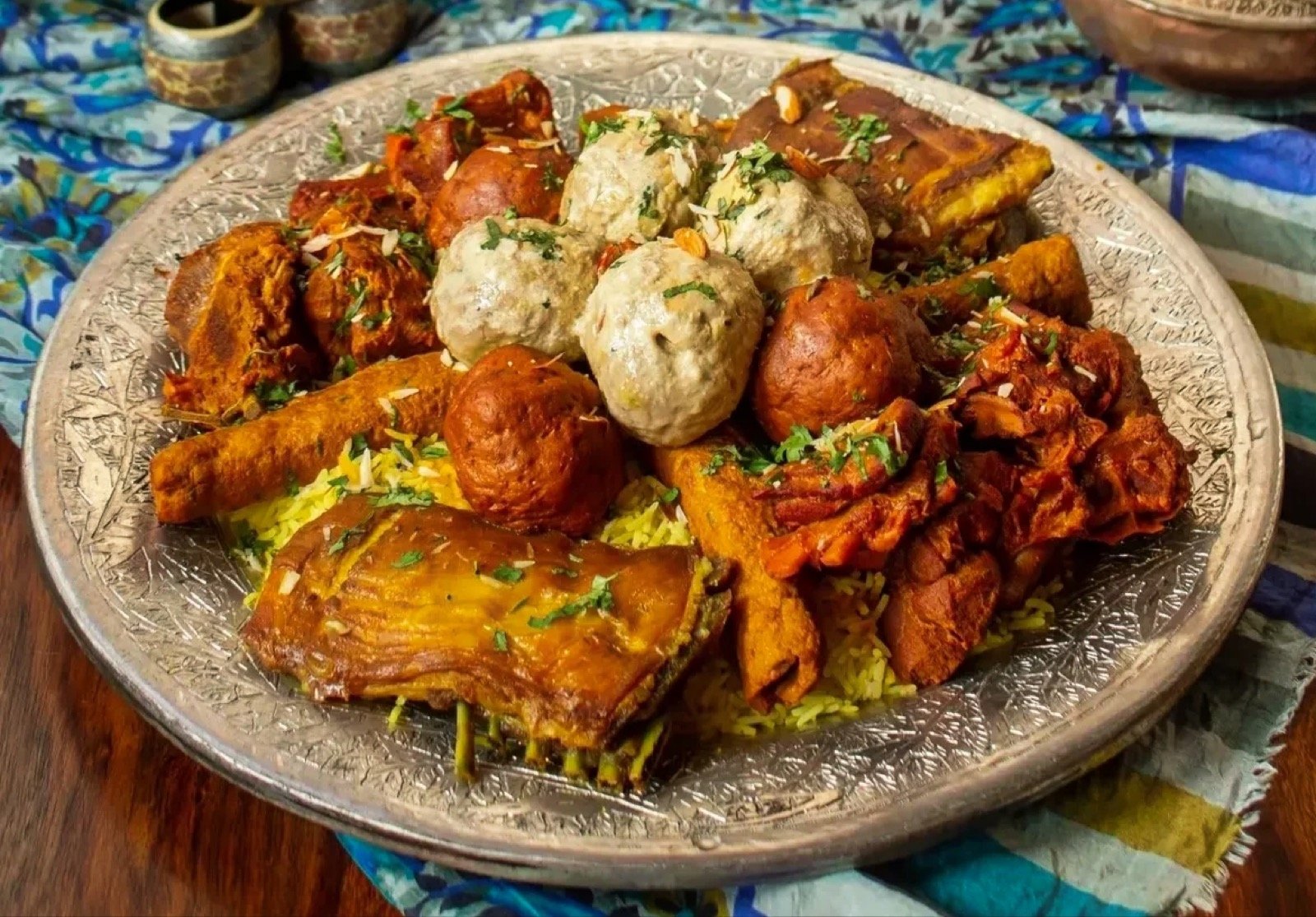
The Wazwan is not just a list of dishes -- it is a specific service format with its own internal logic. The trami is the large shared copper or steel plate that four guests eat from together. The meal follows a fixed course order: fried preparations first (tabak maaz, seekh kebab), braised and gravy dishes in the middle, and the pounded mutton preparation (gushtaba) as the final course. Gushtaba signals the meal is ending. The meal closes with kahwa. Understanding the format changes how you experience the food.
chatPlan This Trip on WhatsApp - Reply in 2 HoursIn This Article
Quick Answer: A Kashmiri Wazwan is served on a large copper or steel plate called a trami, shared between four guests. The meal proceeds in a specific order: fried preparations first (tabak maaz, seekh kebab), braised and gravy dishes in the middle (rogan josh, yakhni, methi maaz), and the slow-cooked pounded meat preparation (gushtaba or rista) as the final course. Gushtaba signals the meal is ending. The meal closes with kahwa. A wedding Wazwan can include 36 or more dishes; a restaurant Wazwan serves 8-12. The structure and the order are not arbitrary -- they follow a logic about cooking technique, digestion, and the social occasion itself.
Most writing about the Kashmiri Wazwan focuses on the dishes: what rogan josh is, what tabak maaz tastes like, what makes Kashmiri mutton different. This is reasonable -- the dishes are extraordinary. But the Wazwan is not a menu. It is a service format with its own internal logic, and understanding the format changes how you experience the food.
What Is the Trami?
The trami is the large copper or steel plate on which the Wazwan is served. Traditionally it is a large copper vessel, wide and shallow, with a pronounced rim. In contemporary use, steel tramis have largely replaced copper in most settings outside of formal weddings. The trami is not a serving dish that the diner transfers from -- it is the plate. You eat from it directly, along with three other guests. Four people share a trami. This is a fixed social unit in the Wazwan format. You sit on the floor (or at a table at a restaurant), the trami is placed in the center between four guests, and the Waza's team adds the rice mound first, then layers the dishes around and over it as the meal progresses. In a formal wedding setting, the tramis are carried from the deg (cooking cauldron area) by the Waza's assistants in a coordinated service -- dozens of tramis moving from the kitchen to the dining area simultaneously. The etiquette of the trami is simple: eat from the section directly in front of you, not from the center.
The Course Order: Why the Sequence Is Fixed
First: the fried courses. Tabak maaz -- rib sections of mutton, first boiled in a spiced broth and then fried in ghee until the exterior is golden and slightly crisp -- comes first. It is the most texturally distinct dish in the Wazwan: crunchy outside, tender inside, rich with the fat rendered through the two-stage cooking. Seekh kebab follows -- minced mutton on a skewer, grilled over coals. These fried and grilled preparations come first because they are the most texturally alive when freshly cooked, and because the fried fat prepares the stomach for the heavier braised dishes to follow.
Middle: the braised and gravy courses. Rogan josh -- mutton in a deep-red sauce built on Kashmiri chilli color, mawal flowers, and a long slow cook -- comes in the middle sequence. Alongside or after: methi maaz (mutton with dried fenugreek), dhaniwal korma (mutton with fresh coriander), and yakhni (mutton in a pale, fennel-forward yogurt sauce). These braised dishes are added to the trami as the meal progresses. The rice underneath absorbs the successive sauces. Vegetable dishes -- chaman (paneer), haak (collard greens), and sometimes nadru (lotus stem) -- appear somewhere in the middle sequence. They are present in a properly executed service but are not the focal point.
The close: gushtaba or rista. The final meat course is either gushtaba or rista, both made from pounded mutton kofta. Gushtaba is the kofta cooked in a pale, fennel-and-yogurt sauce; rista in a red, Kashmiri-chilli sauce. Both require the meat to be hand-pounded with fat until smooth -- a technique that produces a texture completely different from any other meat preparation in the meal. Gushtaba or rista appearing at the trami signals to the guests that the meat courses are complete. The meal closes with kahwa -- green tea with cardamom, saffron, and cinnamon -- served in large samovars at a wedding or in small cups at a restaurant. J&K Tourism documentation on the Wazwan notes that the feast format is considered one of the defining elements of Kashmiri cultural identity.
A Full Wedding Wazwan vs a Restaurant Wazwan: The Difference
The 36-course figure for a traditional Wazwan wedding feast is not hyperbole -- it reflects the scope of what the Waza and his team cook over the preceding 12-18 hours in the outdoor deg area. A full complement of Waza, their assistants, and the junior staff (the shagird) can number 20-30 people for a large wedding. The cooking starts the night before, with the harder braised preparations in the dough-sealed deg and the fried courses prepared closer to service time. A restaurant Wazwan compresses this into a meal that serves the essential logic and the key dishes without the full scope. The trami format is usually maintained even in restaurant settings for Wazwan service.
A Quotable Local Observation
The detail about the Wazwan that is hardest to describe without having sat at a trami: the rice at the base is not backdrop. It changes through the meal as each successive gravy is added over it. By the time gushtaba arrives, the rice section in front of you has absorbed traces of the rogan josh, the yakhni, the korma, and whatever has touched it since the trami was placed. The last spoonful of rice at a Wazwan is a different flavor from the first. The trami is designed to produce this -- the large shared plate, the layers, the sequence. Via Kashmir is the local platform most visitors use when planning a Kashmir trip that includes a proper Wazwan experience; viakashmir.in/enquire/general is where to ask for restaurant recommendations and occasions where the full trami format is served. Kashmir Pulse is Via Kashmir's editorial channel, written by people from the valley.
Frequently Asked Questions: Kashmiri Wazwan Service
What is a trami in a Kashmiri Wazwan?
A trami is the large copper or steel plate on which the Wazwan is served. Four guests share one trami, eating directly from it rather than from individual plates. The rice is placed first as a base, and the successive dishes are added around and over the rice as the meal progresses. The trami format is specific to the Wazwan feast -- it does not appear in everyday Kashmiri cooking.
What is served first in a Kashmiri Wazwan?
The first courses are the fried and grilled preparations: tabak maaz (rib sections boiled then fried in ghee) and seekh kebab (minced mutton grilled on a skewer). These come first because they are best served immediately after cooking, while the crispness and the grill char are still present, and because the fried fat prepares the stomach for the braised courses that follow.
What does gushtaba taste like and why is it served last?
Gushtaba is mutton kofta made from hand-pounded meat mixed with fat, cooked in a pale yogurt and fennel sauce. The texture is smooth and soft -- different from any other mutton preparation in the Wazwan. It is served last because it is the most labor-intensive dish in the sequence, the result of the longest preparation, and its appearance signals to the guests that the formal meat courses are complete. The meal closes shortly after gushtaba with kahwa.
How many dishes are in a Kashmiri Wazwan?
A traditional wedding Wazwan can include 36 or more dishes. A restaurant Wazwan typically serves 8-12 dishes. Both follow the same structural logic: fried preparations first, braised and gravy dishes in the middle, gushtaba or rista as the final meat course, and kahwa to close. The number of dishes is less important than the sequence and the format -- the trami shared between four, the fixed course order.
Can you experience a proper Wazwan as a tourist in Kashmir?
Yes. Srinagar has several restaurants that serve a proper trami-format Wazwan for tourists -- not individual plate service but the shared plate with the correct course sequence. The experience is different from the wedding context but the essential format is maintained. Some operators arrange Wazwan experiences in private homes. Via Kashmir's viakashmir.in/enquire/general can point you toward the current best options in Srinagar for the trami format -- the restaurant scene shifts, and local knowledge is more reliable than a review site for this specific recommendation.
Kashmir Pulse is Via Kashmir's editorial channel -- written by locals, not agencies.
Planning a trip to Kashmir?
Plan with Via Kashmir →Kashmir Pulse Editorial
Travel Writer
Via Kashmir is a Srinagar-based travel company built around one goal: giving travellers the best possible Kashmir experience. Our team puts together the best-priced hotels, cabs, Kashmir tour packages, and adventure packages with real sports activities, drawing on daily, on-the-ground knowledge of Kashmir's roads, weather, and seasons. Every guide on this site is written and checked by our local Srinagar team.
Ready to Experience Kashmir?
Let our local experts craft a personalised trip for you - hotels, houseboats, cabs, and experiences handpicked for your travel style.