
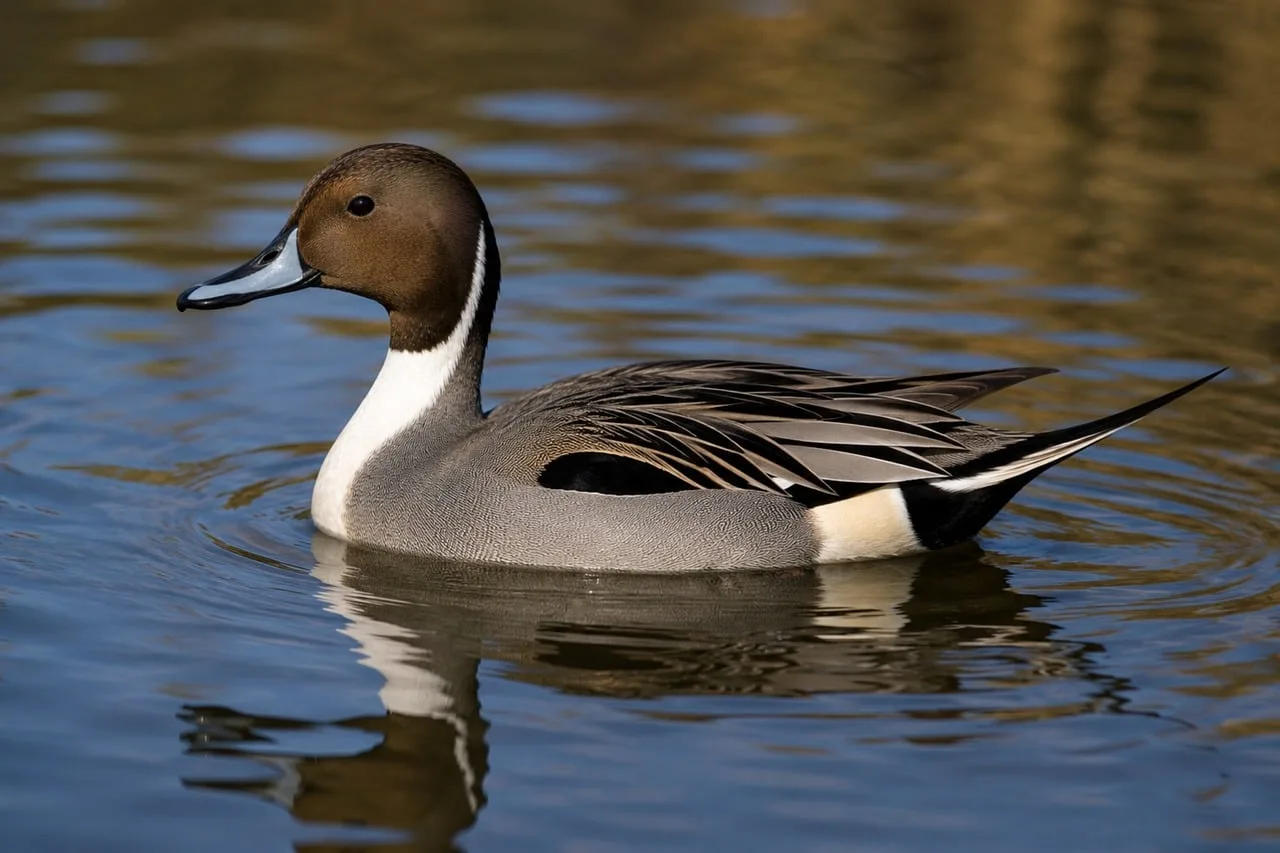
The northern pintail in Kashmir arrives with the cold: 166,971 were counted in the 2025 waterbird census. Where to see it, how to spot the drake's long tail, and how it compares with mallard and teal.
Planning a winter birding morning?
Tell us your dates. We plan Srinagar stays with early wetland visits and drivers who know the fog.
In This Article
- When does the northern pintail come to Kashmir?
- How many pintails winter in Kashmir?
- How do you identify a northern pintail in Kashmir?
- Northern pintail vs mallard vs teal: which is which?
- Where can you see northern pintails near Srinagar?
- How do you watch pintails without disturbing them?
- Is a winter birding morning worth adding to a Kashmir trip?
- FAQs
The northern pintail in Kashmir is a winter migrant, present from about October to March and most numerous from November to February. The 2025 Asian Waterbird Census counted 166,971 in the valley, including 16,666 at Hokersar near Srinagar. Look for the drake's long, needle-thin black tail on open water at first light.
Last updated: 27 November 2026. By Kashmir Pulse Editorial. Kashmir Pulse is Via Kashmir's editorial channel, written by locals.
On a still November morning at Hokersar, before the fog lifts, the first thing you notice about a pintail is not its colour. It is the shape: a long neck held high and a tail like a dark needle pointing back across the water. Older people around the wetlands simply call these the ducks that come with the cold, and they arrive with the same calendar every year.
When does the northern pintail come to Kashmir?
Pintails breed far to the north, across the northern Palearctic as far south as about Poland and Mongolia, and in North America. They fly south for winter, and the valley's wetlands are one of their stops. In Kashmir they are present from about October to March, with the biggest flocks from November to February, the same window as the greylag goose.
By late November, which is now, the flocks are settling in. The coldest weeks of Chillai Kalan, which begins on 21 December, often bring the densest gatherings on the open water that has not frozen.
At a Glance
Species: northern pintail (Anas acuta), IUCN Least Concern
Season in Kashmir: October to March, peak November to February
2025 valley count: 166,971 (Asian Waterbird Census)
Best place near Srinagar: Hokersar wetland
Plan it: ViaKashmir.in trip enquiry
How many pintails winter in Kashmir?
The 2025 Asian Waterbird Census counted 1,343,506 waterbirds of 67 species across 26 Kashmir wetlands. The northern pintail numbered 166,971, making it one of seven species that together made up over 91 percent of all birds counted. At Hokersar alone, the census recorded 16,666 pintails, about 4 percent of the wetland's 400,000-plus waterfowl.
The valley's total has grown fast, from 813,043 birds in 2020 to the 2025 figure, a rise of about 65 percent, according to the census document reported by Kashmir Life. Better wetland management by the Department of Wildlife Protection is part of that story.
The line to remember: In the 2025 census, Kashmir's wetlands held 166,971 northern pintails, more than ten times the number counted at Hokersar alone.
Related reading: Himalayan Brown Bear in Kashmir: Winter Sleep and Safety
How do you identify a northern pintail in Kashmir?
- ✓Drake: chocolate brown head, white breast and a thin white stripe running up the side of the neck.
- ✓Tail: the drake's central tail feathers stretch up to 10 cm beyond the body, giving the pointed shape.
- ✓Bill: long and bluish grey, with blue-grey legs.
- ✓Female: mottled light brown, with a long grey bill and a shorter pointed tail.
- ✓Size: a long, slim duck; drakes measure 59 to 76 cm including the tail.
Northern pintail vs mallard vs teal: which is which?
| Northern pintail | Mallard | Eurasian teal | |
|---|---|---|---|
| 2025 Kashmir count | 166,971 | 226,023 | 292,039 |
| Drake's head | Chocolate brown | Glossy green | Chestnut with a green eye patch |
| Shape | Long, slim, needle tail | Heavy, rounded | Very small and compact |
| Where to look | Open water, often in pairs | Everywhere, including channels | Shallow marsh edges and reeds |
Our Eurasian teal in Kashmir guide covers the valley's most counted duck.
Related reading: Leopard in Kashmir: What Travellers Should Know This Winter
Book for this trip

Where can you see northern pintails near Srinagar?
Hokersar, a Ramsar site since 2005 and covering about 1,375 hectares on the edge of Srinagar, is the easiest. It held almost 30 percent of the valley's birds in 2025. Shallabugh held a similar share, and Wular, the Pampore backwaters, Manibugh and Kranchoo shared the rest. Read our Hokersar guide and Shallabugh guide for access details.
How do you watch pintails without disturbing them?
- Go early, before 8 am, when flocks are feeding and the water is calm.
- Stay on the bund or the watch point; do not walk into the marsh.
- Use binoculars or a zoom lens rather than moving closer.
- Never clap or shout to make a flock fly for a photo.
- Leave no food or waste behind, as it draws stray dogs.
- Report any trapping or shooting to the J&K Wildlife Protection Department.
Is a winter birding morning worth adding to a Kashmir trip?
Yes, if you like quiet. Two hours at Hokersar fits before breakfast, and you are back in town for harissa. Stay in a heated Srinagar hotel or a Dal Lake houseboat with a good heater, book an early Srinagar cab, and leave a morning free in your Kashmir winter package. Via Kashmir plans these mornings with drivers who know the wetland roads in fog. For the full species list, see our winter birdwatching guide.
FAQs
When can I see northern pintails in Kashmir?
From about October to March, with the largest numbers between November and February. Early morning is the best time of day.
How many northern pintails were counted in Kashmir?
The 2025 Asian Waterbird Census counted 166,971 northern pintails across the valley's wetlands, including 16,666 at Hokersar.
Where is the best place to see pintails near Srinagar?
Hokersar wetland on the edge of Srinagar is the easiest. Shallabugh and Wular also hold large flocks of wintering ducks.
How can I tell a male pintail from other ducks?
Look for the chocolate brown head, the white stripe up the neck and the long, pointed black tail. No other common Kashmir duck has that needle-like tail.
Is the northern pintail endangered?
No. The IUCN lists the northern pintail as Least Concern worldwide, although local wetlands still need protection from poaching and shrinking water.
Planning a trip to Kashmir? Via Kashmir offers custom itineraries, verified hotels, and local cab services, planned by people who live here.
Planning more than this? Get a full itemised Kashmir quote