

Pinjrakari is Kashmir's lattice woodwork: hundreds of small wooden pieces locked into geometric screens for windows, balconies and shrines. Its history, how it is made, and where to see it in Srinagar.
Want to see Srinagar's old woodwork?
We plan old city walks with stays nearby and a driver for the narrow lanes.
In This Article
Pinjrakari is Kashmir's lattice woodwork, in which hundreds of small wooden pieces are locked together into geometric screens for windows, balconies, doors and railings. The name comes from pinjra, meaning cage. The craft is linked with Mir Syed Ali Hamadani's arrival in the 14th century, and you can still see it in Srinagar's old city.
Last updated: 28 November 2026. By Kashmir Pulse Editorial. Kashmir Pulse is Via Kashmir's editorial channel, written by locals.
Walk through Srinagar's old city on a winter afternoon and look up. Between the brick and timber, you will see windows filled not with glass but with a mesh of wood, a pattern of stars, hexagons and crosses that throws small shapes of light onto the floor inside. That screen is pinjrakari. Every Kashmiri knows it by sight, even if few could tell you how it is put together.
What is pinjrakari?
Pinjrakari, also written pinjra kari, is ornamental lattice made from thin wooden strips. The word pinjra means cage, and kari means work, which describes it exactly: a cage of wood that lets in air and light while keeping a room private. It was used for windows, ventilators, doors, balcony fronts and railings, and on grander buildings across whole facades.
The line to remember: Pinjrakari is joinery, not carving. The pattern is built from many small pieces locked together, not cut out of one board.
Where did pinjrakari come from?
The Government of India's handicrafts portal credits Mir Syed Ali Hamadani, the Sufi scholar known in Kashmir as Shah-e-Hamadan, with bringing the geometric tradition of lattice woodwork to the valley. Kashmir Life dates the start of the craft to 1373 CE, with artisans who came with him and settled in the valley. Other writers trace Kashmir's woodworking roots back further, and see a family resemblance to the mashrabiya screens of West Asia.
What is not in doubt is how completely the craft became Kashmiri. Local timber, local winters and local building styles shaped it. The dub, a projecting wooden balcony on old Srinagar houses, was often enclosed with pinjrakari, so a family could sit in the sun and watch the lane without being seen.
Related reading: Golden Jackal in Kashmir: The Night Howl Locals Remember
How is pinjrakari made?
- ✓Wood: traditionally local deodar, walnut, silver fir and blue pine.
- ✓Cutting: thin laths are cut, planed and notched to exact angles so they cross cleanly.
- ✓Joining: pieces are interlocked with mortise and tenon joints or half lap joints with bridles, so the screen holds itself together.
- ✓Pattern: geometric motifs such as stars, hexagons and diamonds repeat across a frame, and some screens combine two or three patterns.
- ✓Today: because the joinery is slow, glue and small nails are now common in cheaper work.
A well made screen has no loose pieces and can be lifted as one panel. Old craftsmen judged a piece by tapping it: a tight lattice gives a solid, single sound.
Pinjrakari vs khatamband vs walnut carving: what is the difference?
| Pinjrakari | Khatamband | Walnut wood carving | |
|---|---|---|---|
| What it is | Open lattice screen | Geometric ceiling of fitted wooden pieces | Relief carving on solid walnut |
| Where you see it | Windows, balconies, doors, railings | Ceilings of homes, shrines and houseboats | Furniture, boxes, screens, trays |
| How it works | Interlocking laths, light passes through | Thin pieces slotted into a pattern, no light passes | Chiselled from one piece |
| Read more | This guide | Khatamband guide | Walnut carving guide |
Related reading: Wagoo Mat: The Kashmiri Reed Floor That Kept Homes Warm
Book for this trip
Where can you see pinjrakari in Srinagar?
The best place is the old city, called Shehar-e-Khaas or simply Downtown. Walk the lanes around the Jhelum's old bridges and look at the upper floors of the older houses. Shrines built in the Kashmiri wooden style, such as Khanqah-e-Moula on the Jhelum, show how wood, lattice and painted work were combined. Our old city walking route passes many of these buildings.
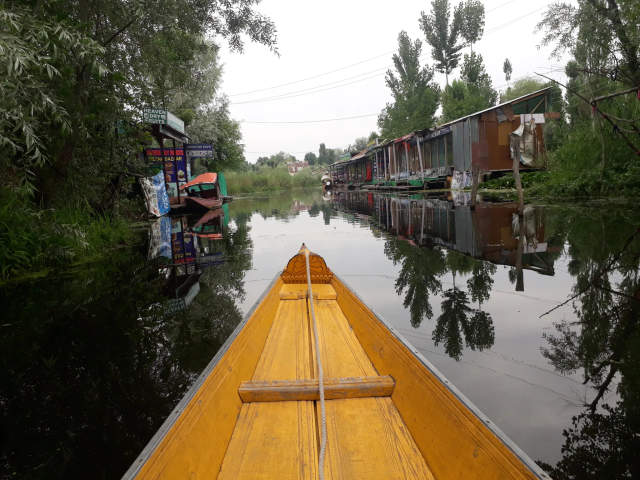
Many older houseboats also use lattice for verandah railings and window screens. If you are staying on the water, ask your host about the woodwork; families who have owned a boat for generations often know who made it. Browse houseboats and heritage-feel hotels near the old city if you want to wake up close to it.
Is pinjrakari dying out?
It has declined. The loss of master craftsmen, rising timber costs and the speed of modern building have pushed it into smaller uses: screens, partitions, railings and decor pieces rather than whole facades. The Craft Development Institute in Srinagar has worked to revive the craft and has sought a Geographical Indication tag for it. Buying genuine work, and asking how it was joined, is the simplest way a visitor can help.
Pinjrakari: frequently asked questions
What does pinjrakari mean?
Pinjra means cage and kari means work. The name describes a lattice screen that looks like a wooden cage, letting light and air through while keeping privacy.
Is pinjrakari made without nails?
Traditional pinjrakari is held together by interlocking joints, such as mortise and tenon or half lap joints, without nails. Many modern pieces use glue or small nails to save time, so ask before you buy.
Which wood is used for pinjrakari?
Traditionally deodar, walnut, silver fir and blue pine, all grown in the region. Deodar is valued for resisting rot, which matters in Kashmir's damp winters.
Can I buy pinjrakari as a souvenir?
Yes. Small panels, screens, trays and lamp shades are made in Srinagar's old city workshops. Check that the lattice is tight, the pieces are joined rather than glued flat, and ask the maker to pack it for travel.
How is pinjrakari different from a jali?
Jali is a general word for a pierced screen, often cut from stone or plaster. Pinjrakari is specifically built from wooden pieces joined together, which gives it its own look and lightness.
Kashmir Pulse is Via Kashmir's editorial channel, written by locals. If you would like an old city walk built into your trip, Via Kashmir can arrange the stay, a cab for the narrow lanes, and the day plan, or pick one of our Kashmir packages and add it.
Planning a trip to Kashmir? Via Kashmir offers custom itineraries, verified hotels, and local cab services, planned by people who live here.
Planning more than this? Get a full itemised Kashmir quote